Choose the correct statement with respect to long run production function-
(A) There is no fixed factor of production.
(B) All inputs can be varied.
(C) Average and Marginal cost curves are U shaped.
(D) Decreasing Returns to Scale is not applicable.
Choose the correct answer from the options given below:
Answer & explanation
Correct answer: option 2
The correct answer is Option (2) → (A), (B) and (C) only
A production function shows how much output a firm gets from its inputs, such as labour and capital. It is studied over two time spans:
Short run: at least one input, such as the factory building, is fixed; output changes only through the variable input, and the Law of Variable Proportions applies.
Long run: all inputs can be varied, so there is no fixed factor. The firm can change its whole scale of production, and what happens to output when all inputs rise in the same proportion is described by returns to scale: increasing, constant or decreasing.
Returns to scale also shape the long run cost curves: cost per unit falls while returns are increasing and rises once they become decreasing.
(A) There is no fixed factor of production. Correct. Every input can be adjusted in the long run, so no factor remains fixed; this is what separates the long run from the short run.
(B) All inputs can be varied. Correct. This is the same feature seen from the other side: every input, capital included, can be changed, so the firm can alter its whole scale of production.
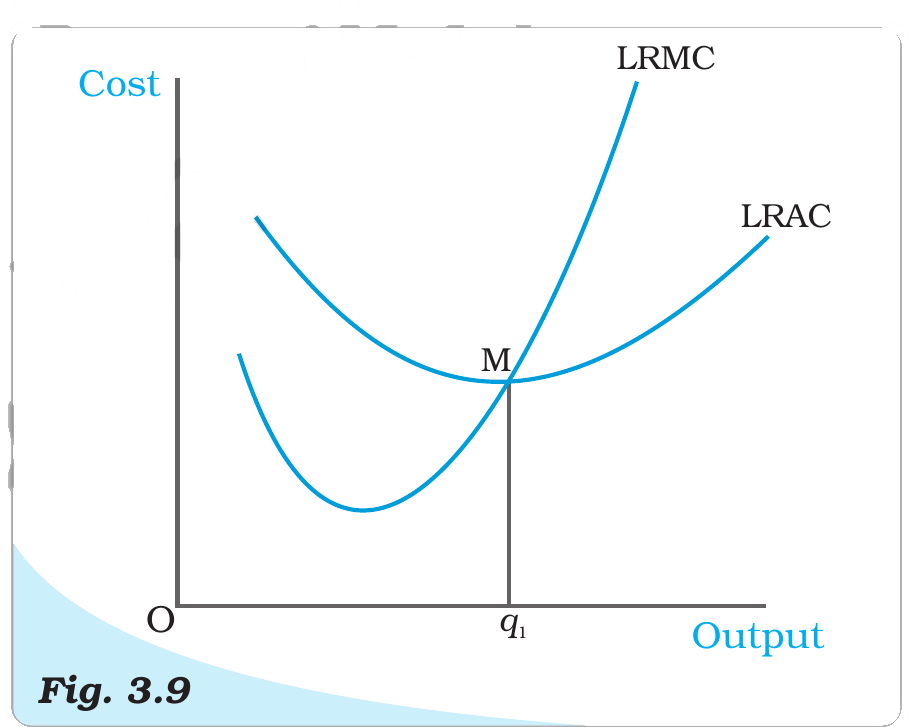
(C) Average and Marginal cost curves are U shaped. Correct. Increasing returns at low output make the long run average cost fall, and decreasing returns at high output make it rise, so the LRAC curve is U-shaped. The long run marginal cost curve is U-shaped too, cutting LRAC from below at its minimum point.
(D) Decreasing Returns to Scale is not applicable. Incorrect. Decreasing returns to scale hold when a proportional increase in all inputs raises output by a smaller proportion, and this can happen only in the long run, when all inputs are varied. It is the reason the long run average cost curve rises beyond its minimum point.
NCERT (2025-26): “3.2 The Short Run and the Long Run … In the long run, all factors of production can be varied. A firm in order to produce different levels of output in the long run may vary both the inputs simultaneously. So, in the long run, there is no fixed factor.… It is argued that in a typical firm IRS is observed at the initial level of production. This is then followed by the CRS and then by the DRS. Accordingly, the LRAC curve is a ‘U’-shaped curve. Its downward sloping part corresponds to IRS and upward rising part corresponds to DRS. At the minimum point of the LRAC curve, CRS is observed. Let us check how the LRMC curve looks like. For the first unit of output, both LRMC and LRAC are the same. Then, as output increases, LRAC initially falls, and then, after a certain point, it rises. As long as average cost is falling, marginal cost must be less than the average cost. When the average cost is rising, marginal cost must be greater than the average cost. LRMC curve is therefore a ‘U’-shaped curve. It cuts the LRAC curve from below At the minimum point of the LRAC. Figure 3.9 shows the shapes of the long run marginal cost and the long run average cost curves for a typical firm.…”
|