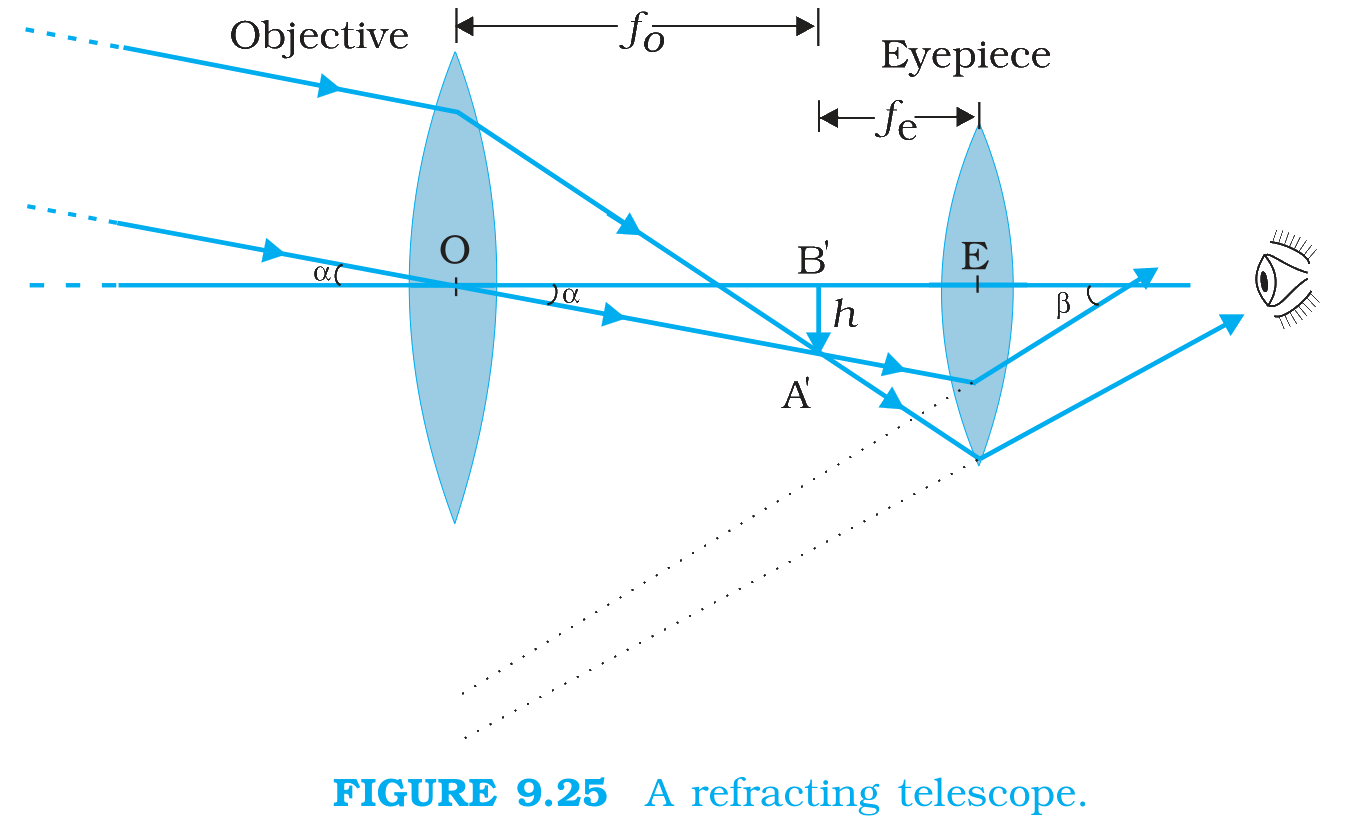
An astronomical telescope essentially consists of
Answer & explanation
Correct answer: option 2
The correct answer is Option (2) → two convex lenses
Option (1) two concave lenses — Incorrect. A concave lens has negative power and spreads out a parallel beam. So an objective made of it cannot bring the light from a distant star to a real image in the tube.
Option (2) two convex lenses — Correct. The objective is a convex lens of large focal length and large aperture. It forms a real image of the distant object at its second focal point. The eyepiece, a convex lens of small focal length, then magnifies this image, like a simple microscope.
Option (3) one concave and one convex lens — Incorrect. Both lenses of an astronomical telescope must converge light. One forms the real image and the other magnifies it. A concave lens in either place cannot do this.
Option (4) two plano-concave lenses — Incorrect. A plano-concave lens is thinner at the centre than at the edge, so it is a diverging lens. Two such lenses form only a virtual, diminished image and give no magnification.
NCERT (2026-27):
Telescope – “The telescope is used to provide angular magnification of distant objects (Fig. 9.25). It also has an objective and an eyepiece. But here, the objective has a large focal length and a much larger aperture than the eyepiece. Light from a distant object enters the objective and a real image is formed in the tube at its second focal point. The eyepiece magnifies this image producing a final inverted image.”