Which of the following complexes will have highest magnitude of the crystal field splitting?
Answer & explanation
Correct answer: option 1
The correct answer is Option (1) → [Fe(CN)6]3−
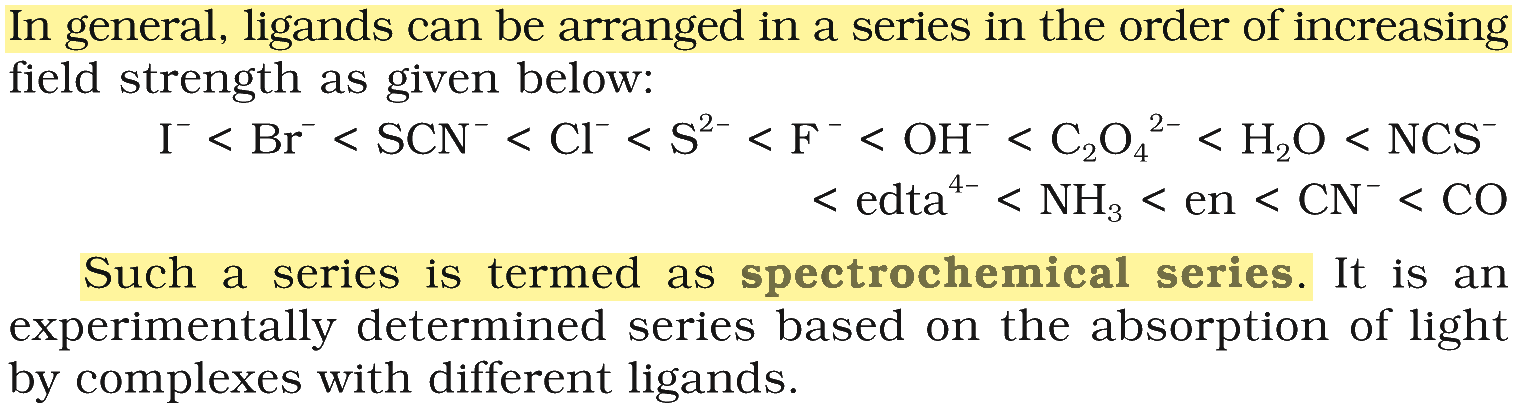
In an octahedral complex the ligands split the five d orbitals into a lower t2g set and a higher eg set. The energy gap is the crystal field splitting, Δo. For the same metal ion in the same oxidation state, Δo depends on the field strength of the ligand, given by the spectrochemical series.
The charge balance gives iron +3 in every complex: x + 6(−1) = −3 with \( \ce{CN^{-}} \) or \( \ce{F^{-}} \), and x + 6(0) = +3 with \( \ce{NH3} \) or \( \ce{H2O} \). So all four complexes contain \( \ce{Fe^{3+}} \) with six identical ligands, and only the ligand decides. Among the four ligands:
\( \ce{F^{-}} \) < \( \ce{H2O} \) < \( \ce{NH3} \) < \( \ce{CN^{-}} \)
\( \ce{CN^{-}} \) is a strong field ligand, so [Fe(CN)6]3− has the largest Δo.
Why the other options are incorrect
Option (2) [FeF6]3− — Incorrect. \( \ce{F^{-}} \) is a weak field ligand, the weakest of the four, so this complex has the smallest Δo and is high spin.
Option (3) [Fe(NH3)6]3+ — Incorrect. \( \ce{NH3} \) is stronger than \( \ce{H2O} \) but weaker than \( \ce{CN^{-}} \).
Option (4) [Fe(H2O)6]3+ — Incorrect. \( \ce{H2O} \) is a weak field ligand, placed below \( \ce{NH3} \) and \( \ce{CN^{-}} \).
NCERT (2026-27 edition):
Crystal Field Theory – …