The molar conductivity and limiting molar conductivity of acetic acid at concentration c, is \( \Lambda_m \) and \( \Lambda_m^{\circ} \), respectively. If α is the degree of dissociation, the dissociation constant of acetic acid is represented as:
Answer & explanation
Correct answer: option 3
The correct answer is Option (3) → \( \displaystyle \frac{c\Lambda_m^2}{\Lambda_m^{\circ}(\Lambda_m^{\circ}-\Lambda_m)} \)
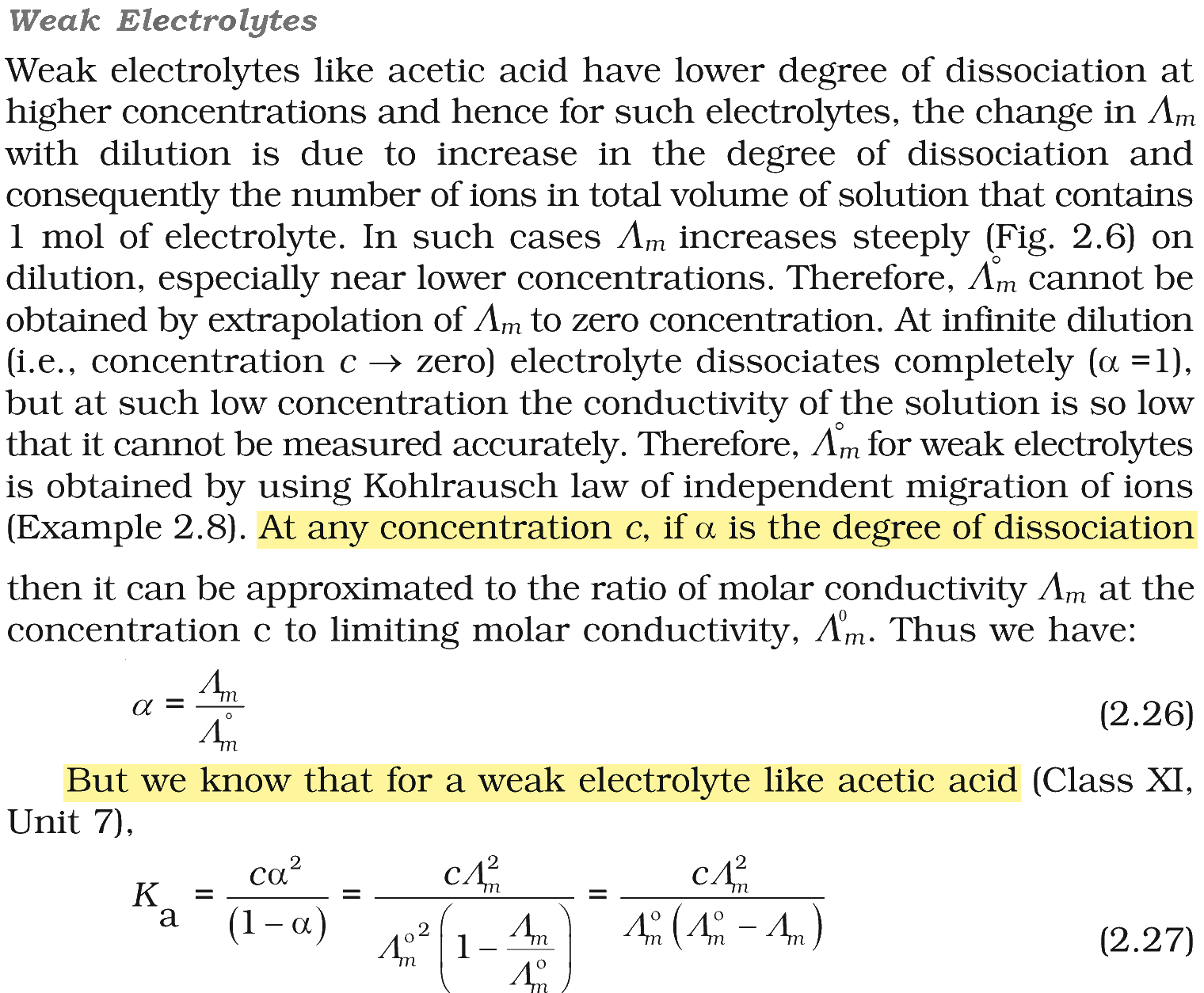
Acetic acid is a weak electrolyte: it dissociates only partly, and the fraction dissociated is the degree of dissociation α. At infinite dilution it dissociates completely, so the ratio of the molar conductivity at concentration c to the limiting molar conductivity gives α:
\( \displaystyle \alpha=\frac{\Lambda_m}{\Lambda_m^{\circ}} \)
For the dissociation equilibrium, starting with concentration c:
\( \displaystyle \ce{CH3COOH <=> CH3COO^- + H^+} \)
\( \displaystyle \text{At equilibrium: } c(1-\alpha)\qquad c\alpha\qquad c\alpha \)
\( \displaystyle K_a=\frac{c\alpha\cdot c\alpha}{c(1-\alpha)}=\frac{c\alpha^2}{1-\alpha} \)
Substituting α = Λm/Λm°:
\( \displaystyle K_a=\frac{c\left(\frac{\Lambda_m}{\Lambda_m^{\circ}}\right)^2}{1-\frac{\Lambda_m}{\Lambda_m^{\circ}}} \)
\( \displaystyle K_a=\frac{c\Lambda_m^2}{(\Lambda_m^{\circ})^2}\times\frac{\Lambda_m^{\circ}}{\Lambda_m^{\circ}-\Lambda_m} \)
\( \displaystyle K_a=\frac{c\Lambda_m^2}{\Lambda_m^{\circ}(\Lambda_m^{\circ}-\Lambda_m)} \)
So the dissociation constant of acetic acid is cΛm2 / Λm°(Λm° − Λm).
Why the other options are incorrect
Option (1) — Incorrect. Λm in the numerator is not squared; Ka depends on α2, so Λm must appear squared.
Option (2) — Incorrect. The factor outside the bracket in the denominator should be Λm°, not Λm.
Option (4) — Incorrect. Since Λm is always smaller than Λm°, the bracket (Λm − Λm°) is negative and Ka would come out negative, which is impossible.
NCERT (2026-27 edition):
Weak Electrolytes