
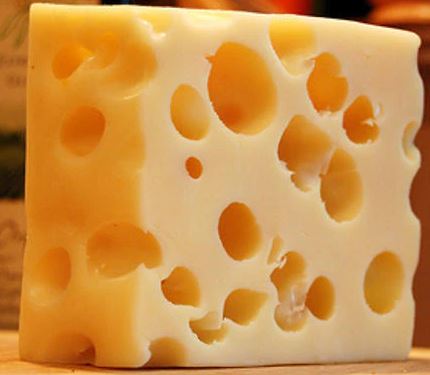
Observe the following block of cheese:
Read the following two statements:
Statement I: The large holes in Swiss cheese, such as the block shown, are due to the production of a large amount of CO2 by a bacterium.
Statement II: ‘Roquefort cheese’ is ripened by growing a specific bacterium on it.
In the light of the above statements, choose the correct answer from the options given below:
Answer & explanation
Correct answer: option 3
The correct answer is Option (3) → Statement I is true but Statement II is false
Cheese is one of the oldest foods made with microbes. Each variety gets its own texture, flavour and taste from the microbes used. The block shown has large round holes, the mark of Swiss cheese.
Statement I: The large holes in Swiss cheese, such as the block shown, are due to the production of a large amount of CO2 by a bacterium. — True. The bacterium Propionibacterium sharmanii releases a large amount of CO2 in the cheese, and the trapped gas leaves the large holes.
Statement II: ‘Roquefort cheese’ is ripened by growing a specific bacterium on it. — False. Roquefort cheese is ripened by growing a specific fungus on it, which gives it a particular flavour. It is not ripened by a bacterium.
NCERT Extract:
Microbes in Household Products – “… Cheese, is one of the oldest food items in which microbes were used. Different varieties of cheese are known by their characteristic texture, flavour and taste, the specificity coming from the microbes used. For example, the large holes in ‘Swiss cheese’ are due to production of a large amount of CO2 by a bacterium named Propionibacterium sharmanii. The ‘Roquefort cheese’ are ripened by growing a specific fungi on them, which gives them a particular flavour.”