
CUETMOCK
  • Pricing
  • Mentors
Log inStart freeStart free mocks→

First test, then trust

Try a free CUET mock test.

Join 5,00,000+ students who rehearsed exam day on the exact NTA screen before sitting CUET. On the web and on Android.

Start free mocks →Get the Android app
CUETMOCK

India's #1 CUET Mock Test Platform. Original NCERT-based questions on the exact NTA exam screen — trusted by 5,00,000+ students since CUET 2022.

Get it onGoogle PlayScan to download the CUETMOCK app

Mock tests

  • CUET mock test series
  • Commerce mocks
  • Humanities (Arts) mocks
  • Science mocks
  • Languages & GAT mocks
  • Free practice questions
  • Pricing

Resources

  • CUET exam guide
  • CUET syllabus
  • Universities accepting CUET
  • Expert blogs
  • News & notifications
  • Webinars & counselling
  • CUET score calculator
  • How we estimate your rank
  • FAQs

Company

  • About us
  • Our leadership & team
  • Our toppers
  • Mentors
  • For schools
  • Contact us
  • Terms
  • Privacy
  • Refund policy

Talk to us

+91 7696 6630 56info@cuetmock.comWhatsApp us

Our other platforms

  • JEE Mock — For IIT-JEE aspirants
  • NEET Mock — For NEET aspirants

Newsletter

Exam updates, study material and offers — no spam.

© 2026 NYC Ventures Pvt. Ltd.

701-702, Royal Business Park, Zirakpur, Punjab - 140603

  • Terms of use
  • Privacy policy
  • Refund policy
  • Contact us

iCUETMOCK is an independent preparation platform, not affiliated with the National Testing Agency (NTA). Always check exam details on the official NTA website.

  • Home
  • Mock tests
  • CUET guide
  • Pricing
  • Log in
Home/Practice questions/Physics
PhysicsElectric Charges and Fields

In the figure given below, plate 1 and plate 2 are separated by a sma…

In the figure given below, plate 1 and plate 2 are separated by a small distance d. If the air is the medium between the plates, then
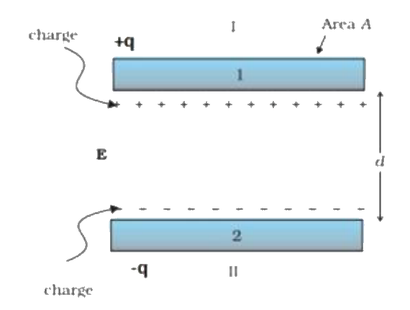
Figure for the question

A. The direction of the electric field is from plate 1 to plate 2.
B. The direction of the electric field is from plate 2 to plate 1.
C. The electric field in region I (region above plate 1) is zero.
D. The electric field in the region between plates is zero.

Choose the correct answer from the options given below:

Answer & explanation+

Correct answer: option 3

The correct answer is Option (3) → A and C only

Each large charged plate produces a uniform field \( \sigma/2\varepsilon_0 \) on each side, directed away from a positive plate and towards a negative plate (\( \sigma = q/A \)); the field at any point is the sum of the two.

    \( \displaystyle \text{Between the plates: } E = \frac{\sigma}{2\varepsilon_0} + \frac{\sigma}{2\varepsilon_0} = \frac{\sigma}{\varepsilon_0} = \frac{q}{A\varepsilon_0} \)

    \( \displaystyle \text{Outside the plates: } E = \frac{\sigma}{2\varepsilon_0} - \frac{\sigma}{2\varepsilon_0} = 0 \)

(A) The direction of the electric field is from plate 1 to plate 2. — Correct. Between the plates the field of the positive plate 1 (away from it) and that of the negative plate 2 (towards it) both point from plate 1 to plate 2.

(B) The direction of the electric field is from plate 2 to plate 1. — Incorrect. Field lines run from the positive plate to the negative plate, not the other way.

(C) The electric field in region I (region above plate 1) is zero. — Correct. Above plate 1 the field of plate 1 points upwards and that of plate 2 points downwards, with equal magnitudes, so they cancel.

(D) The electric field in the region between plates is zero. — Incorrect. Between the plates the two fields add, giving \( E = \sigma/\varepsilon_0 \).

NCERT (2026-27):
The Parallel Plate Capacitor – “… Plate 1 has surface charge density \( \sigma = Q/A \) and plate 2 has a surface charge density \( -\sigma \). Using Eq. (1.33), the electric field in different regions is:

Outer region I (region above the plate 1),

    \( \displaystyle E = \frac{\sigma}{2\varepsilon_0} - \frac{\sigma}{2\varepsilon_0} = 0 \qquad (2.39) \)

Outer region II (region below the plate 2),

    \( \displaystyle E = \frac{\sigma}{2\varepsilon_0} - \frac{\sigma}{2\varepsilon_0} = 0 \qquad (2.40) \)

In the inner region between the plates 1 and 2, the electric fields due to the two charged plates add up, giving

    \( \displaystyle E = \frac{\sigma}{2\varepsilon_0} + \frac{\sigma}{2\varepsilon_0} = \frac{\sigma}{\varepsilon_0} = \frac{Q}{\varepsilon_0 A} \qquad (2.41) \)

The direction of electric field is from the positive to the negative plate.”

Advertisement

Practise more on Electric Charges and Fields

Chapter-wise mocks on the real NTA exam screen, with solutions and your rank. Your first mocks are free.

Start free mocks →

Advertisement

Next questions

  1. The tendency of the group to take more extreme decisions than individuals alone is called:Psychology · Social Influence and Group Processes
  2. Who painted the painting shown above?Fine Arts · The Bengal School and Cultural Nationalism
  3. According to which Buddhist text, Asoka distributed portions of the Buddha’s relics to important towns and ordered the construction of stup…History · Ancient India: Thinkers, Beliefs and Buildings
  4. The two polynucleotide chains of a DNA molecule are: (i) Identical (ii) Complementary to each other w.r.t. base pairs (iii) A specific puri…Biology · Molecular Basis of Inheritance
  5. Which of the following sentences use a pun?(A) The tyre-shop owner sighed that business had been rather flat all month.(B) The bicycle bell…English · Figure of Speech
  6. Select the option figure that should take the place of the question mark in the matrix.General Aptitude Test · Non-Verbal Reasoning
  7. Without tables or a calculator, evaluate exactly the difference (5cos 76^°)/(sin 14^°)-(sec 26^°)/(cosec 64^°) .General Aptitude Test · Quantitative Reasoning
  8. Choose the correct meaning of the Latin phrase “MEA CULPA”.English · Foreign/Latin Words
  9. निम्नलिखित में से कौन-सा शब्द सर्वनाम है?Hindi · सर्वनाम
  10. 'मानवता' शब्द में प्रयुक्त प्रत्यय है-Hindi · प्रत्यय