
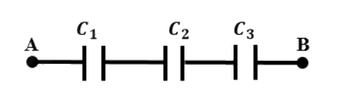
Three capacitors of capacitances C1 = 60 μF, C2 = 30 μF and C3 = 15 μF are connected in series as shown in the figure. If point A is kept at 70 V and point B is earthed, then the potential difference between the plates of C2 is
Answer & explanation
Correct answer: option 1
The correct answer is Option (1) → 20 V
In a series combination every capacitor carries the same charge, equal to the charge on the equivalent capacitor. B is earthed, so the potential difference across the combination is 70 V − 0 = 70 V.
\( \displaystyle \frac{1}{C_{\mathrm{eq}}} = \frac{1}{60} + \frac{1}{30} + \frac{1}{15} = \frac{1 + 2 + 4}{60} = \frac{7}{60}\,\mu\mathrm{F^{-1}} \)
\( \displaystyle C_{\mathrm{eq}} = \frac{60}{7}\,\mu\mathrm{F} \)
\( \displaystyle Q = C_{\mathrm{eq}}V = \frac{60}{7}\,\mu\mathrm{F} \times 70\,\mathrm{V} = 600\,\mu\mathrm{C} \)
\( \displaystyle V_2 = \frac{Q}{C_2} = \frac{600\,\mu\mathrm{C}}{30\,\mu\mathrm{F}} \)
\( V_2 = 20\,\mathrm{V} \)
Shortcut: With a common charge, \( V = Q/C \), so the voltages divide in the inverse ratio of the capacitances: \( \frac{1}{60} : \frac{1}{30} : \frac{1}{15} = 1 : 2 : 4 \). Hence \( V_2 = \frac{2}{7} \times 70\,\mathrm{V} = 20\,\mathrm{V} \) (and 10 V, 40 V across \( C_1 \), \( C_3 \)).