
The pie chart shows the distribution (in degrees) of 3000 students among five classes A, B, C, D and E.
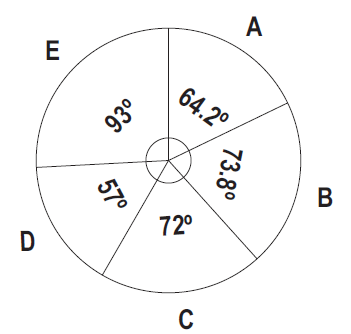
The number of students in classes A and B together is what percent more than the number of students in classes C and D together (approximately)?
Answer & explanation
Correct answer: option 2
The correct answer is Option (2) → 6.98%
The number of students in a class is proportional to its angle, so the comparison can be made with the degrees directly; the total of 3000 is not needed. The base of “more than” is classes C and D.
A and B: \(64.2^\circ+73.8^\circ=138^\circ\)
C and D: \(72^\circ+57^\circ=129^\circ\)
Difference \(=138^\circ-129^\circ=9^\circ\)
Percentage \(\displaystyle =\frac{9}{129}\times100=6.98\%\) (approximately)
In numbers of students this is 1150 against 1075, and \(\displaystyle\frac{75}{1075}\times100\) gives the same 6.98%.