
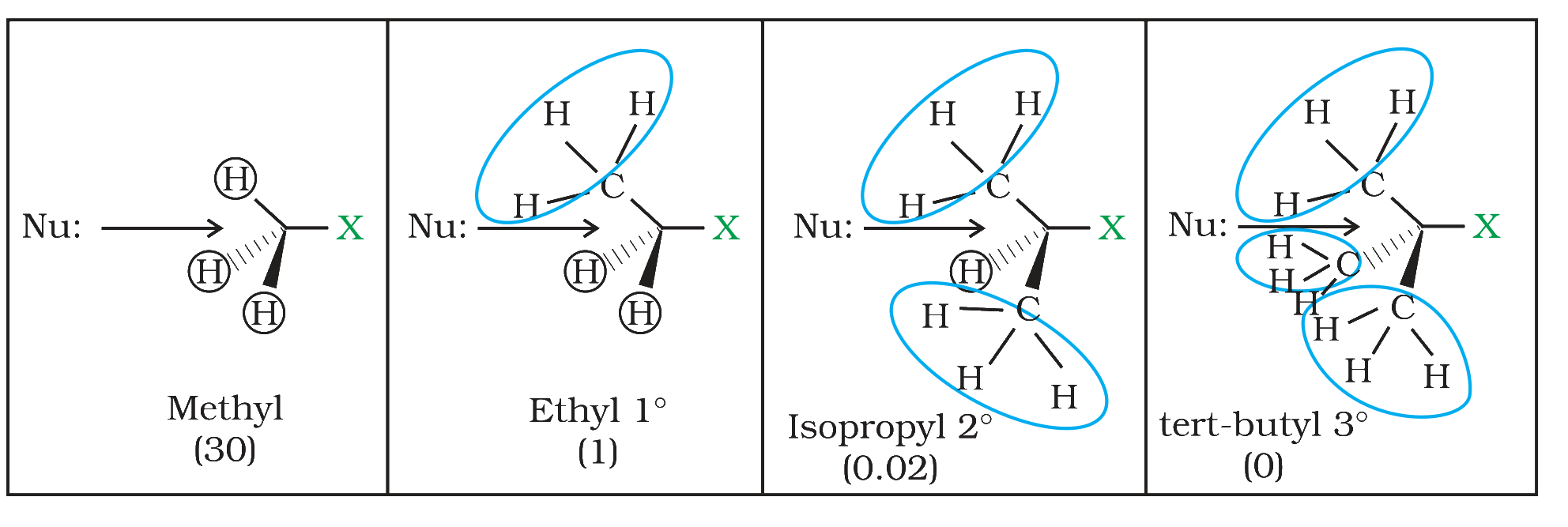
The figure shows a nucleophile (Nu:) approaching four alkyl halides in an SN2 reaction, with the relative rate of each reaction given in parenthesis.
About how many times faster does the methyl halide react than the ethyl halide, and why is the ethyl halide slower?
Answer & explanation
Correct answer: option 1
The correct answer is Option (1) → About 30 times; its CH3 group hinders the approach of the nucleophile.
In an SN2 reaction the nucleophile must reach the carbon that carries X, from the side opposite to X.
Rate ratio — about 30 times. Methyl (30) ÷ ethyl (1) = 30.
Reason — steric hindrance. The methyl halide has only three small H atoms on that carbon. In the ethyl halide one H is replaced by the circled CH3 group, which crowds the path of Nu: and slows the reaction.
Why the other options are incorrect
Option (2) About 30 times; its CH3 group stabilises the carbocation formed. — Incorrect. The ratio is right, but no carbocation forms in an SN2 reaction; carbocation stability decides SN1 rates.
Option (3) About 50 times; its CH3 group stabilises the carbocation formed. — Incorrect. 1 ÷ 0.02 = 50 compares ethyl with isopropyl, not methyl with ethyl, and no carbocation forms in an SN2 reaction.
Option (4) About 50 times; its CH3 group hinders the approach of the nucleophile. — Incorrect. The reason is right, but 50 is the ethyl to isopropyl ratio (1 ÷ 0.02), not the methyl to ethyl ratio.
NCERT (2026-27 edition):
6.7.1 Reactions of Haloalkanes – “Since this reaction requires the approach of the nucleophile to the carbon bearing the leaving group, the presence of bulky substituents on or near the carbon atom have a dramatic inhibiting effect. Of the simple alkyl halides, methyl halides react most rapidly in SN2 reactions because there are only three small hydrogen atoms. Tertiary halides are the least reactive because bulky groups hinder the approaching nucleophiles.”
Fig. 6.3: Steric effects in SN2 reaction. The relative rate of SN2 reaction is given in parenthesis