
CUETMOCK
  • Pricing
  • Mentors
Log inStart freeStart free mocks→

First test, then trust

Try a free CUET mock test.

Join 5,00,000+ students who rehearsed exam day on the exact NTA screen before sitting CUET. On the web and on Android.

Start free mocks →Get the Android app
CUETMOCK

India's #1 CUET Mock Test Platform. Original NCERT-based questions on the exact NTA exam screen — trusted by 5,00,000+ students since CUET 2022.

Get it onGoogle PlayScan to download the CUETMOCK app

Mock tests

  • CUET mock test series
  • Commerce mocks
  • Humanities (Arts) mocks
  • Science mocks
  • Languages & GAT mocks
  • Free practice questions
  • Pricing

Resources

  • CUET exam guide
  • CUET syllabus
  • Universities accepting CUET
  • Expert blogs
  • News & notifications
  • Webinars & counselling
  • CUET score calculator
  • How we estimate your rank
  • FAQs

Company

  • About us
  • Our leadership & team
  • Our toppers
  • Mentors
  • For schools
  • Contact us
  • Terms
  • Privacy
  • Refund policy

Talk to us

+91 7696 6630 56info@cuetmock.comWhatsApp us

Our other platforms

  • JEE Mock — For IIT-JEE aspirants
  • NEET Mock — For NEET aspirants

Newsletter

Exam updates, study material and offers — no spam.

© 2026 NYC Ventures Pvt. Ltd.

701-702, Royal Business Park, Zirakpur, Punjab - 140603

  • Terms of use
  • Privacy policy
  • Refund policy
  • Contact us

iCUETMOCK is an independent preparation platform, not affiliated with the National Testing Agency (NTA). Always check exam details on the official NTA website.

  • Home
  • Mock tests
  • CUET guide
  • Pricing
  • Log in
Home/Practice questions/Biology
BiologyEvolution

How many of the following are examples of homology?A. Vertebrate hear…

How many of the following are examples of homology?

A. Vertebrate hearts
B. Thorn of Bougainvillea and tendril of Cucurbita
C. Flippers of penguins and of dolphins
D. Forelimbs of whales, bats, cheetah and human
E. Wings of butterfly and of birds

Choose the correct answer from the options given below:

Answer & explanation+

Correct answer: option 2

The correct answer is Option (2) → Three

Homologous structures have the same basic structure but perform different functions; they come from common ancestry through divergent evolution. Analogous structures do the same function but are not anatomically similar; they come from convergent evolution.

A. Vertebrate hearts — Homology. NCERT gives vertebrate hearts and brains as further examples of homology.

B. Thorn of Bougainvillea and tendril of Cucurbita — Homology. Both are modified stems, one for protection and the other for climbing.

C. Flippers of penguins and of dolphins — Analogy. A bird and a mammal have come to have similar flippers for swimming in a similar habitat.

D. Forelimbs of whales, bats, cheetah and human — Homology. All four have humerus, radius, ulna, carpals, metacarpals and phalanges, though they swim, fly, run or hold things.

E. Wings of butterfly and of birds — Analogy. Both are used for flying, but they are not anatomically similar.

So A, B and D are examples of homology, which makes three.

NCERT Extract:
What are the Evidences for Evolution? – “… For example whales, bats, Cheetah and human (all mammals) share similarities in the pattern of bones of forelimbs (Figure 6.3b). … This is divergent evolution and these structures are homologous. Homology indicates common ancestry. Other examples are vertebrate hearts or brains. In plants also, the thorn and tendrils of Bougainvillea and Cucurbita represent homology (Figure 6.3a).”
What are the Evidences for Evolution? – “… Homology is based on divergent evolution whereas analogy refers to a situation exactly opposite. Wings of butterfly and of birds look alike. They are not anatomically similar structures though they perform similar functions. … Other examples of analogy are the eye of the octopus and of mammals or the flippers of Penguins and Dolphins.”
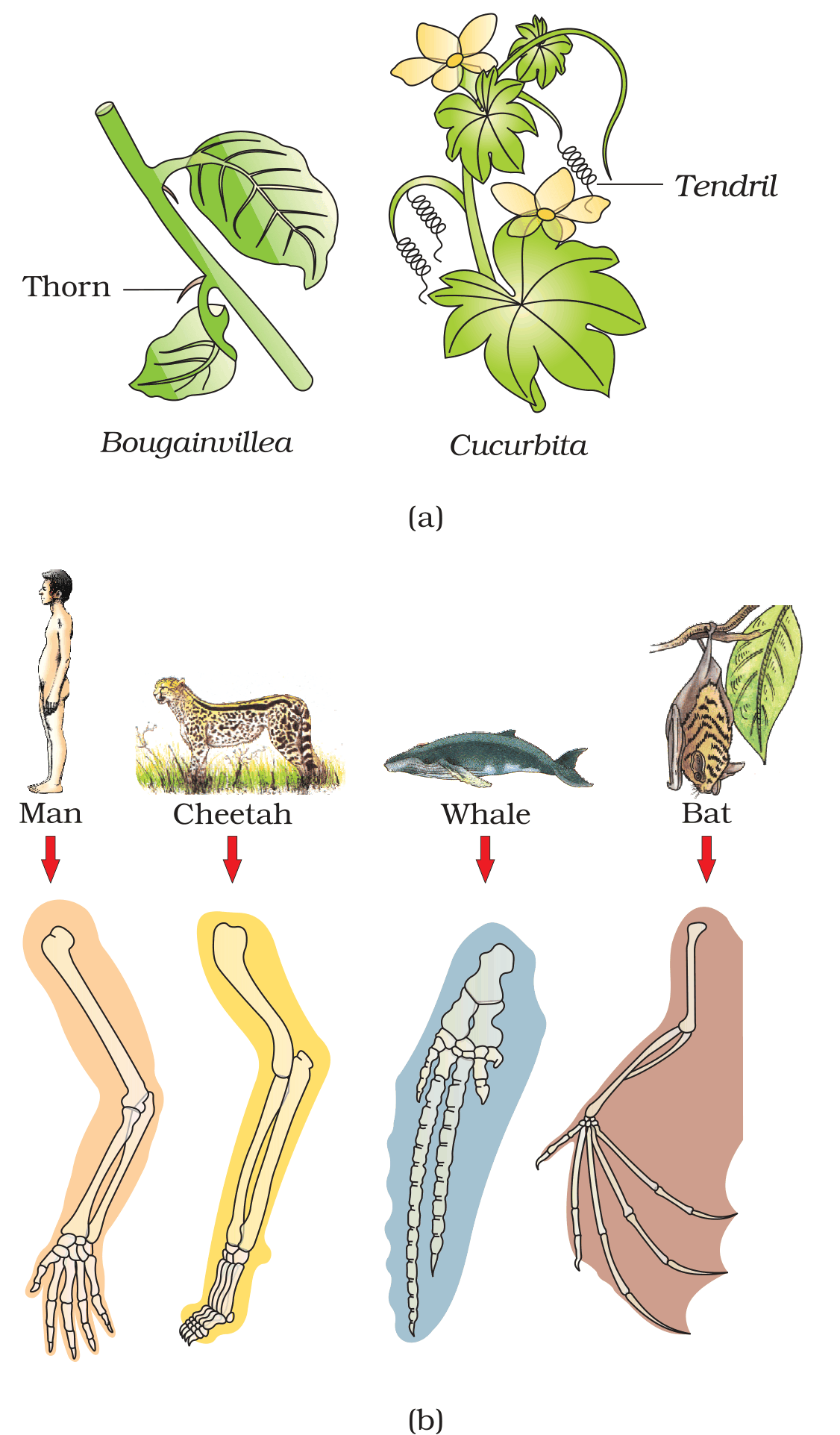
Textbook figure

Figure 6.3 Example of homologous organs in (a) Plants and (b) Animals

Advertisement

Practise more on Evolution

Chapter-wise mocks on the real NTA exam screen, with solutions and your rank. Your first mocks are free.

Start free mocks →

Advertisement

Next questions

  1. The mean of 8 observations is fixed at 15. The number of observations that are free to vary, that is, the number of degrees of freedom, isApplied Maths. Section B2 · Inferential Statistics
  2. Match List-I with List-II.List-IList-II(A) Kinetics of the reaction of chloromethane with hydroxide ion(I) First order kinetics(B) Kinetics…Chemistry · Organic: Haloalkanes and Haloarenes
  3. In the Kalakacharyakatha, how is Acharya Kalaka related to the abducted woman he sets out to rescue?Fine Arts · The Manuscript Painting Tradition
  4. If ‘P # Q’ means ‘P is the brother of Q’, ‘P Q’ means ‘P is the father of Q’ and ‘P % Q’ means ‘P is the mother of Q’, then in the expressi…General Aptitude Test · Verbal Reasoning
  5. In 1896, E. B. Havell and Abanindranath Tagore began to Indianise art education at the Government Art School, now the Government College of…Fine Arts · The Bengal School and Cultural Nationalism
  6. ∫_0^1(x^3)/(1+x^8) dx is equal toApplied Maths. Section A · Definite Integration
  7. The line MN is a mirror standing to the right of EQRUF. Which option shows the image seen in it?General Aptitude Test · Non-Verbal Reasoning
  8. Who was responsible for constructing the first recombinant DNA?Biology · Biotechnology -Principles and Processes
  9. Let L be the line passing through the points A(1, 2, −1) and B(3, −2, 3). (A) The direction ratios of L are 2, −4, 4(B) The point (5, −6, 7…Maths. Section B1 · Three-dimensional Geometry
  10. Which of the following statements about the emperor's order in the court chronicle is correct?History · Medieval India: Peasants, Zamindars and the State