Which of the following reagents is used to distinguish between ethanol and phenol?
Answer & explanation
Correct answer: option 2
The correct answer is Option (2) → Bromine water
A test that distinguishes two compounds must give a visible result with one and not with the other. A reaction that both compounds undergo in the same way is useless as a test.
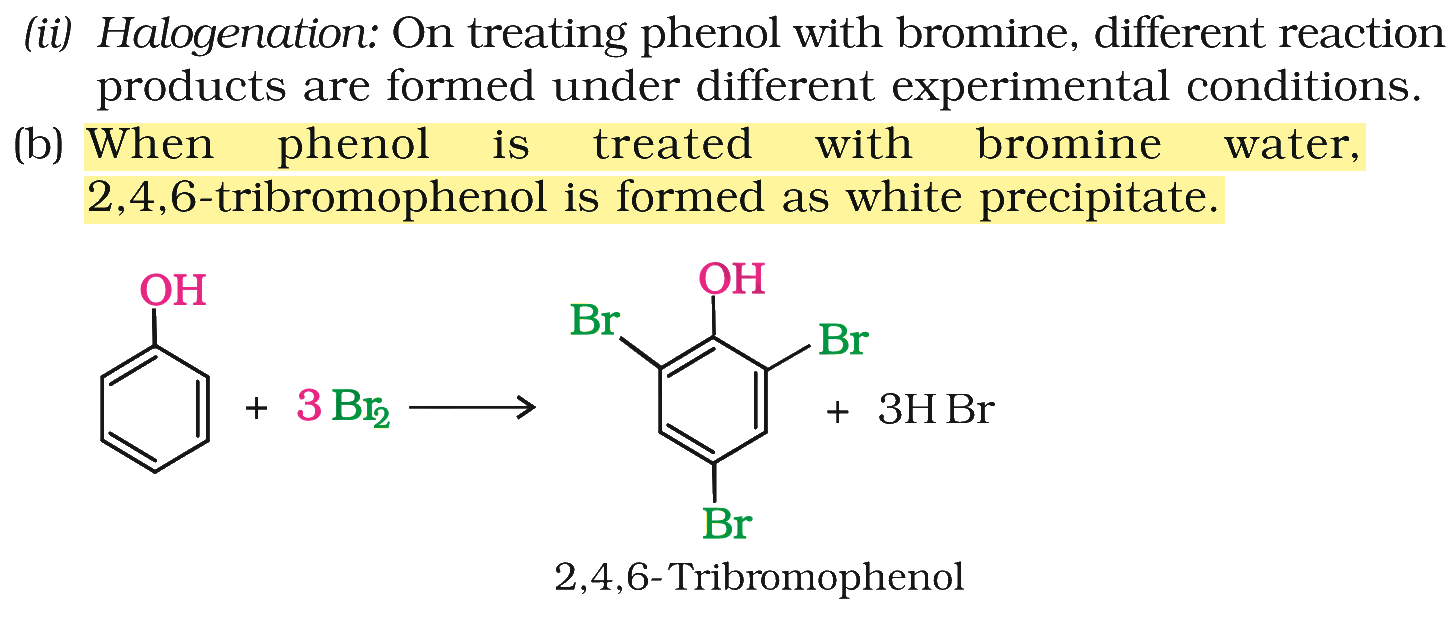
In phenol, the –OH group releases electrons into the benzene ring by resonance, so the ring is strongly activated towards electrophilic substitution. With bromine water, phenol reacts at once at room temperature: the brown colour of bromine disappears and a white precipitate of 2,4,6-tribromophenol forms.
Ethanol has no aromatic ring and gives no such precipitate. So bromine water distinguishes ethanol from phenol.
Why the other options are incorrect
Option (1) Sodium Metal — Incorrect. Both ethanol and phenol have an acidic O–H and both give \( \ce{H2} \) gas with sodium, so the result looks the same:
\( \displaystyle \ce{2C2H5OH + 2Na -> 2C2H5ONa + H2 ^} \)
\( \displaystyle \ce{2C6H5OH + 2Na -> 2C6H5ONa + H2 ^} \)
Option (3) Acetic anhydride — Incorrect. Both are acetylated to colourless esters (ethyl acetate and phenyl acetate) with no visible difference:
\( \displaystyle \ce{C2H5OH + (CH3CO)2O} \xrightarrow{\ce{H^+}} \ce{CH3COOC2H5 + CH3COOH} \)
\( \displaystyle \ce{C6H5OH + (CH3CO)2O} \xrightarrow{\ce{H^+}} \ce{CH3COOC6H5 + CH3COOH} \)
Option (4) Acetyl chloride — Incorrect. It also acetylates both compounds in the same way, giving esters and HCl:
\( \displaystyle \ce{C2H5OH + CH3COCl} \xrightarrow{\text{pyridine}} \ce{CH3COOC2H5 + HCl} \)
\( \displaystyle \ce{C6H5OH + CH3COCl} \xrightarrow{\text{pyridine}} \ce{CH3COOC6H5 + HCl} \)
NCERT (2026-27 edition):
Halogenation