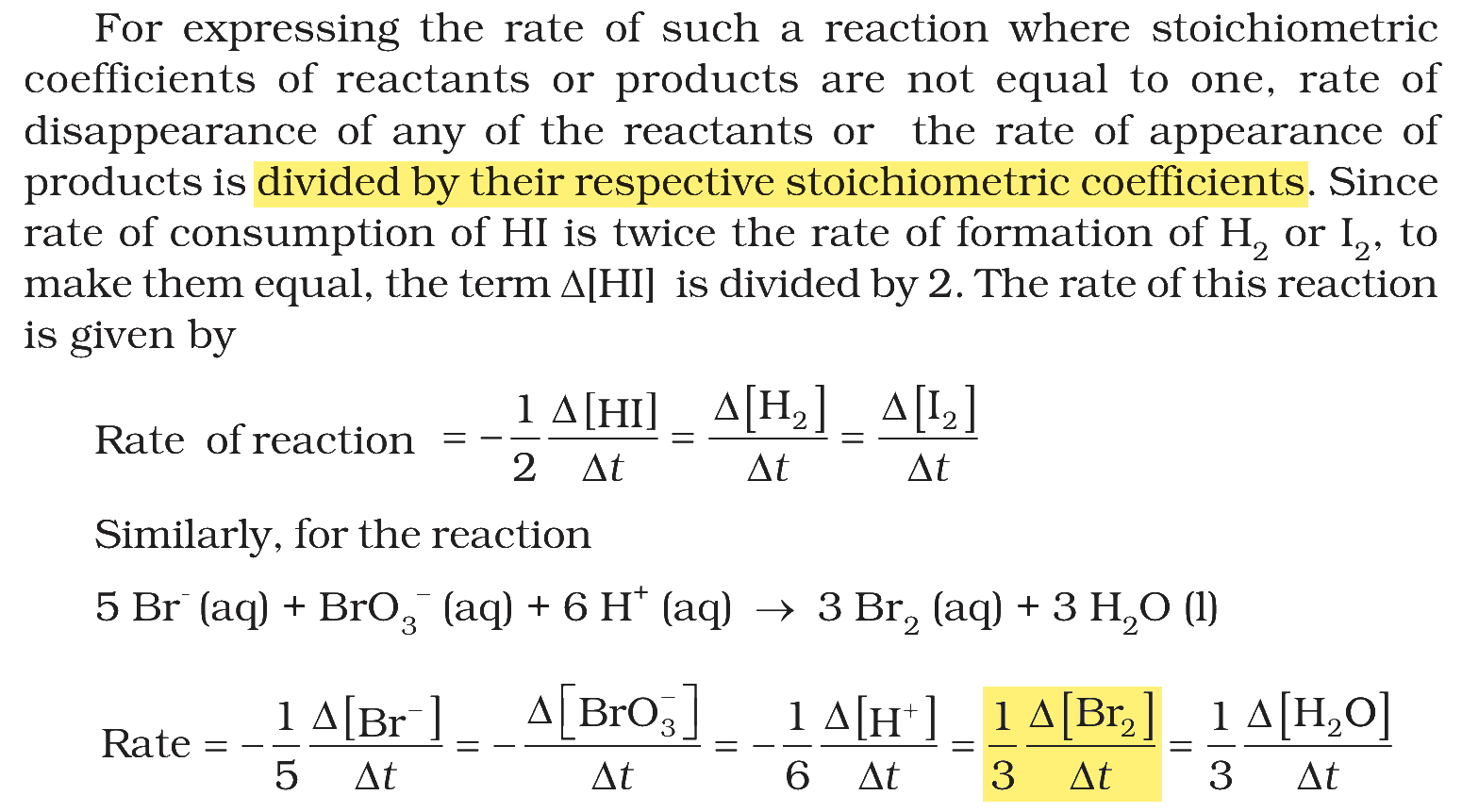
For the following reaction choose the incorrect expression of rate of reaction.
5 Br− (aq.) + BrO3− (aq.) + 6 H+ (aq.) → 3 Br2 (aq.) + 3 H2O (l)
Answer & explanation
Correct answer: option 3
The correct answer is Option (3) → \( \displaystyle \text{Rate}=-\frac{1}{3}\frac{\Delta[\ce{Br2}]}{\Delta t} \)
The rate of a reaction must have one positive value, whichever species is followed. So the rate of change of each concentration is divided by the stoichiometric coefficient of that species, and the sign is chosen to make the rate positive:
Reactants are used up, so Δ[reactant] is negative and a minus sign is put in front.
Products are formed, so Δ[product] is positive and a plus sign is used.
For the given reaction, the rate written for each species is:
\( \displaystyle \text{Rate}=-\frac{1}{5}\frac{\Delta[\ce{Br^-}]}{\Delta t}=-\frac{\Delta[\ce{BrO3^-}]}{\Delta t} \)
\( \displaystyle =-\frac{1}{6}\frac{\Delta[\ce{H^+}]}{\Delta t}=+\frac{1}{3}\frac{\Delta[\ce{Br2}]}{\Delta t}=+\frac{1}{3}\frac{\Delta[\ce{H2O}]}{\Delta t} \)
Option (1) \( \displaystyle \text{Rate}=-\frac{1}{5}\frac{\Delta[\ce{Br^-}]}{\Delta t} \) — A correct expression. Br− is a reactant with coefficient 5, so the minus sign and the factor 1/5 are both right.
Option (2) \( \displaystyle \text{Rate}=-\frac{1}{6}\frac{\Delta[\ce{H^+}]}{\Delta t} \) — A correct expression. H+ is a reactant with coefficient 6, so the minus sign and the factor 1/6 are both right.
Option (3) \( \displaystyle \text{Rate}=-\frac{1}{3}\frac{\Delta[\ce{Br2}]}{\Delta t} \) — The incorrect expression. The factor 1/3 is right, but Br2 is a product. Its concentration increases, so Δ[Br2] is positive, and a minus sign in front would make the rate negative. The correct term carries a plus sign: Rate = +(1/3)Δ[Br2]/Δt.
Option (4) \( \displaystyle \text{Rate}=-\frac{\Delta[\ce{BrO3^-}]}{\Delta t} \) — A correct expression. BrO3− is a reactant with coefficient 1, so only the minus sign is needed.
NCERT (2026-27 edition):
Rate of a Chemical Reaction