What can be the product of Hoffmann bromamide degradation reaction?
Answer & explanation
Correct answer: option 3
The correct answer is Option (3) → \(CH_3NH_2\)
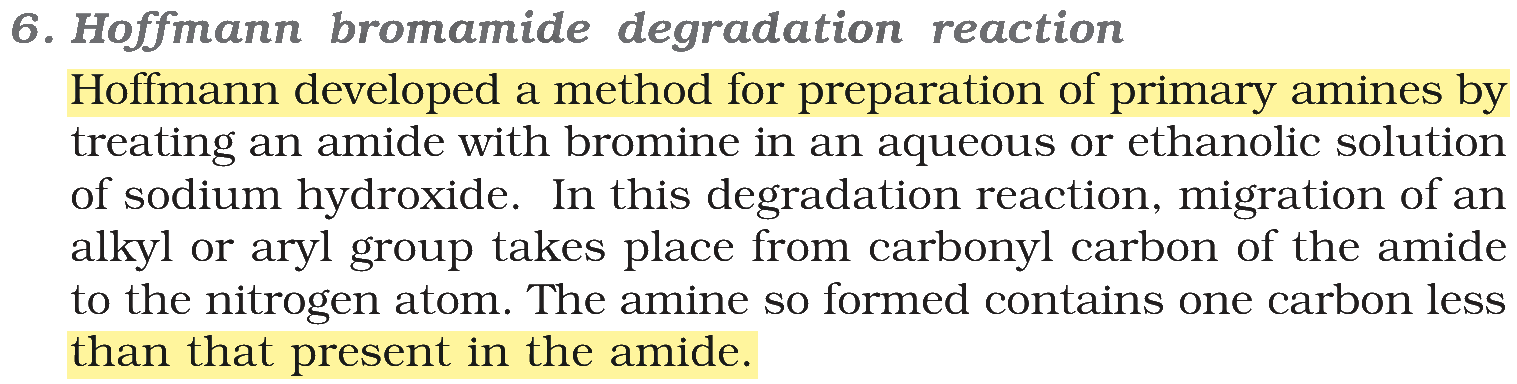
The Hoffmann bromamide degradation converts an amide into a primary amine with one carbon atom less:
\( \displaystyle \ce{R-CONH2 + Br2 + 4NaOH -> R-NH2 + Na2CO3 + 2NaBr + 2H2O} \)
With ethanamide (R = \( \ce{CH3} \)) the product is methanamine:
\( \displaystyle \ce{CH3CONH2 + Br2 + 4NaOH -> CH3NH2 + Na2CO3 + 2NaBr + 2H2O} \)
So the product that can be formed is \( \ce{CH3NH2} \), a primary amine.
Why the other options are incorrect
Option (1) \((CH_3)_2NH\) — Incorrect. Dimethylamine is a secondary amine. Only one R group migrates to the nitrogen of \( \ce{-CONH2} \), so the nitrogen ends up with one carbon group and two hydrogens.
Option (2) \((CH_3)_3N\) — Incorrect. Trimethylamine is a tertiary amine; it cannot form for the same reason.
Option (4) \(NH_3\) — Incorrect. Ammonia has no carbon group on nitrogen. The reaction places the R group of the amide on nitrogen, so its product always carries an alkyl or aryl group.
NCERT (2026-27 edition):
Hoffmann Bromamide Degradation Reaction