
Williamson ether synthesis is an example of which type of substitution?
Answer & explanation
Correct answer: option 2
The correct answer is option 2. Nucleophilic.
Williamson ether synthesis is an example of a nucleophilic substitution reaction. The Williamson ether synthesis involves the reaction of an alkoxide ion with a primary alkyl halide or a tosylate. The mechanism is typically an \(S_N2\) (bimolecular nucleophilic substitution) process.
Nucleophile: The alkoxide ion \((R_1O^-)\) acts as a strong nucleophile.
Electrophile: The alkyl halide (R-X, where X is a halogen) provides an electrophilic carbon.
The nucleophilic alkoxide attacks the electrophilic carbon, displacing the halide ion (X⁻) and forming an ether \((R_1-O-R)\).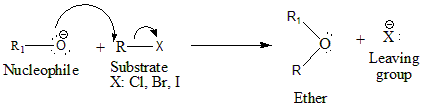
Therefore, Williamson ether synthesis is an example of Nucleophilic substitution.