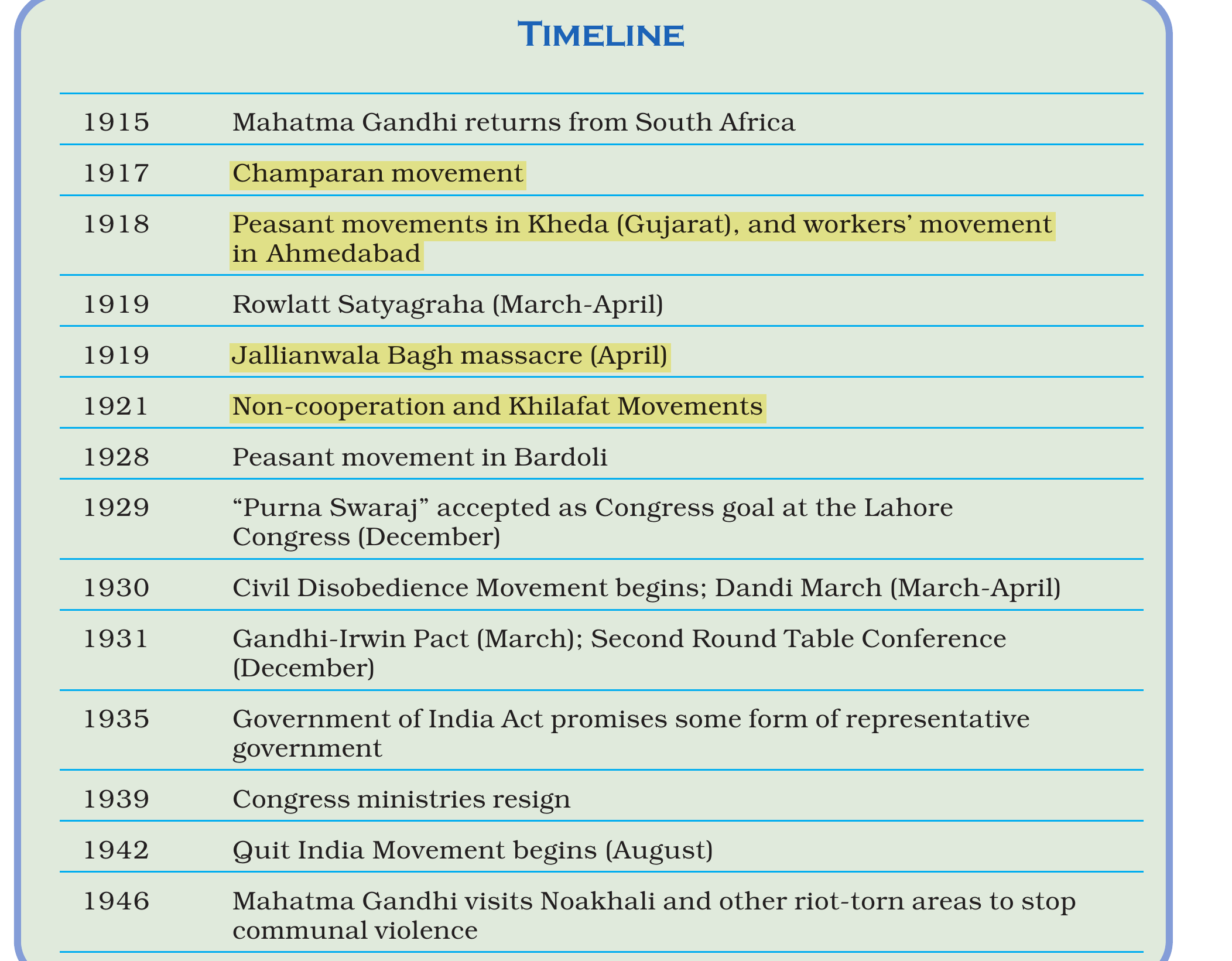
Arrange the events in chronological order:
(A) Champaran Movement.
(B) Jallianwala Bagh Massacre.
(C) Chauri Chaura Incident.
(D) Workers' Movement in Ahmedabad.
(E) Non-Cooperation Movement.
Choose the correct answer from the options given below:
Answer & explanation
Correct answer: option 1
The correct answer is Option (1) → (A), (D), (B), (E), (C)
(A) Champaran Movement — 1917, the earliest of the five.
(D) Workers’ Movement in Ahmedabad — 1918, the same year as the peasant movement in Kheda.
(B) Jallianwala Bagh Massacre — April 1919, during the Rowlatt Satyagraha, when a British Brigadier ordered his troops to open fire on a nationalist meeting.
(E) Non-Cooperation Movement — 1921; emboldened by the success of the Rowlatt Satyagraha, Gandhiji called for a campaign of non-cooperation with British rule.
(C) Chauri Chaura Incident — February 1922: peasants torched a police station in the hamlet of Chauri Chaura, and this act of violence prompted Gandhiji to call off the Non-Cooperation Movement, so it comes last.
Tip: Five questions of this paper are answered straight from the timelines printed at the end of the chapters. Read every chapter’s timeline row by row before the exam.
NCERT (2026-27): “2.1 Knitting a popular movement … As a consequence of the Non-Cooperation Movement the British Raj was shaken to its foundations for the first time since the Revolt of 1857. Then, in February 1922, a group of peasants attacked and torched a police station in the hamlet of Chauri Chaura, in the United Provinces (now, Uttar Pradesh and Uttaranchal). Several constables perished in the conflagration. This act of violence prompted Gandhiji to call off the movement altogether.…”
|