
Read the passage carefully and answer the questions.
The resistance (R) of an object is given by the expression \( ρ\frac{l}{A} \). The inverse of R is called conductance and the inverse of \( ρ \) is called conductivity or specific conductance represented by K. The conductivity depends upon the nature of the material (insulator, semiconductor or conductor) and the temperature of the substance. Similarly, the conductance due to the ions present in the solution (ionic conductance) depends upon the nature of the electrolyte, size of the ions produced, the nature of the solvent and the temperature. Molar conductivity (\( Λ_m \)) of a solution at a given concentration is the conductance of the volume V of solution containing one mole of electrolyte kept between two electrodes with area of cross-section A and the distance of unit length. It is given by the expression, \( Λ_m = kV \). Molar conductivity increases with the decrease in concentration and when the concentration approaches zero, it is called limiting molar conductivity. The decrease is linear in the case of a strong electrolyte. However, in the case of a weak electrolyte, the change in molar conductivity is gradual in the higher concentration range and there is a sharp increase in molar conductivity as the concentration approaches zero. From the limiting molar conductivity values of a strong electrolyte, we can find the limiting molar conductivity of a weak electrolyte containing the common ions using the Kohlrausch law of independent migration of ions. From molar conductivity and limiting molar conductivity, we can Am determine the degree of dissociation (\( \frac{Λ_m}{Λ_m^o} \)) and ionization constant of a weak acid.
Limiting molar conductivity values for \( HCl, NaCl \) and \( CH_3COONa \) are 425.9, 126.4 and \( 91.0\, S\, cm^2\, mol^{-1} \), respectively. Calculate the limiting molar conductivity value for acetic acid.
Answer & explanation
Correct answer: option 3
The correct answer is Option (3) → 390.5 S cm2 mol−1
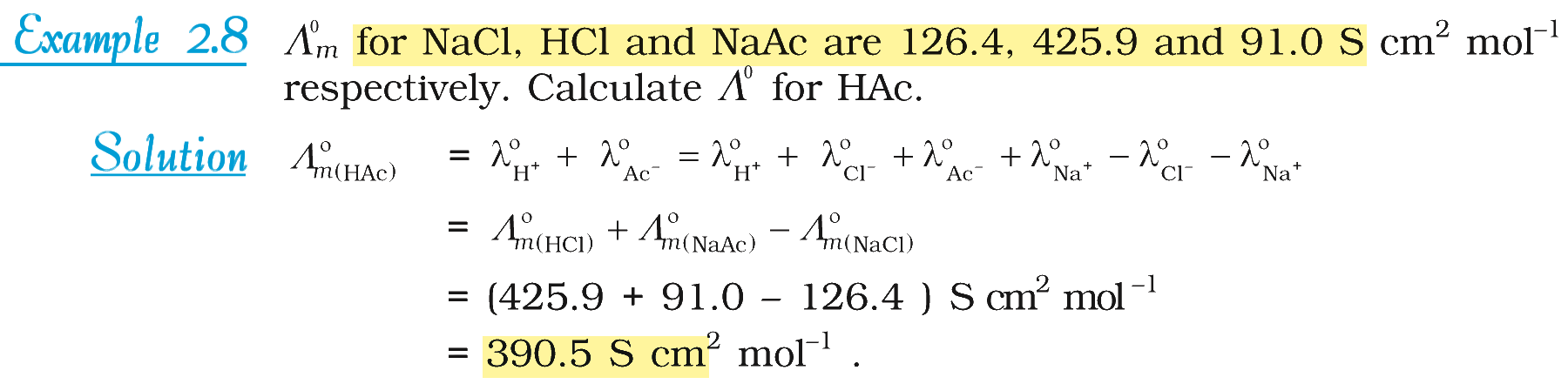
By Kohlrausch’s law of independent migration of ions, the limiting molar conductivity of an electrolyte is the sum of the contributions of its cation and anion. So Λ°m of a weak electrolyte such as acetic acid (HAc) can be found from strong electrolytes that together supply the same ions:
\( \displaystyle \Lambda^{\circ}_m(\mathrm{HAc})=\Lambda^{\circ}_m(\mathrm{HCl})+\Lambda^{\circ}_m(\mathrm{NaAc})-\Lambda^{\circ}_m(\mathrm{NaCl}) \)
This works because the \( \ce{Na^{+}} \) and \( \ce{Cl^{-}} \) contributions cancel:
\( \displaystyle =[\lambda^{\circ}_{H^+}+\lambda^{\circ}_{Cl^-}]+[\lambda^{\circ}_{Na^+}+\lambda^{\circ}_{Ac^-}]-[\lambda^{\circ}_{Na^+}+\lambda^{\circ}_{Cl^-}] \)
\( \displaystyle =\lambda^{\circ}_{H^+}+\lambda^{\circ}_{Ac^-} \)
Substituting the values:
\( \displaystyle \Lambda^{\circ}_m(\mathrm{HAc})=425.9+91.0-126.4 \)
\( \displaystyle =390.5\ \mathrm{S\,cm^2\,mol^{-1}} \)
Note 1: This question is from NCERT (2026-27). NTA sets numerical questions from NCERT too, so do not ignore NCERT while practising numericals.
NCERT (2026-27 edition):
Variation of Conductivity and Molar Conductivity with Concentration – …
Note 2: The same/similar question has been asked in different years by NTA as per the details given below:
| 2026 | 2025 | 2024 | 2023 | 2022 |
|---|---|---|---|---|
| 11-05 S1 | 03-06 S2 28-05 S1 22-05 S1 15-05 S1 | – | – | 20-08 S1 10-08 S1 |