
CUETMOCK
  • Pricing
  • Mentors
Log inStart freeStart free mocks→

First test, then trust

Try a free CUET mock test.

Join 5,00,000+ students who rehearsed exam day on the exact NTA screen before sitting CUET. On the web and on Android.

Start free mocks →Get the Android app
CUETMOCK

India's #1 CUET Mock Test Platform. Original NCERT-based questions on the exact NTA exam screen — trusted by 5,00,000+ students since CUET 2022.

Get it onGoogle PlayScan to download the CUETMOCK app

Mock tests

  • CUET mock test series
  • Browse all papers
  • Commerce mocks
  • Humanities (Arts) mocks
  • Science mocks
  • Languages & GAT mocks
  • Free practice questions
  • Pricing

Resources

  • CUET exam guide
  • CUET syllabus
  • Universities accepting CUET
  • Expert blogs
  • News & notifications
  • Webinars & counselling
  • CUET score calculator
  • How we estimate your rank
  • FAQs

Company

  • About us
  • Our leadership & team
  • Our toppers
  • Mentors
  • For schools
  • Contact us
  • Terms
  • Privacy
  • Refund policy

Talk to us

+91 7696 6630 56info@cuetmock.comWhatsApp us

Our other platforms

  • JEE Mock — For IIT-JEE aspirants
  • NEET Mock — For NEET aspirants

Newsletter

Exam updates, study material and offers — no spam.

© 2026 NYC Ventures Pvt. Ltd.

701-702, Royal Business Park, Zirakpur, Punjab - 140603

  • Terms of use
  • Privacy policy
  • Refund policy
  • Contact us

iCUETMOCK is an independent preparation platform, not affiliated with the National Testing Agency (NTA). Always check exam details on the official NTA website.

  • Home
  • Mock tests
  • CUET guide
  • Pricing
  • Log in
Home/Practice questions/Biology
BiologyReproduction in Organisms

Identify the type of asexual reproductive structure:
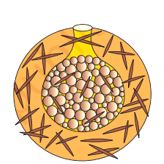
Identify the type of asexual reproductive structure:

Answer & explanation+

Correct answer: option 2

The correct answer is Option (2)-Gemmules.

Members of the Kingdom Fungi and simple plants such as algae reproduce through special asexual reproductive structures . The most common of these structures are zoospores that usually are microscopic motile structures. Other common asexual reproductive structures are conidia (Penicillium), buds (Hydra) and gemmules (sponge).

Gemmules are internal buds found in sponges and are involved in asexual reproduction . It is an asexually reproduced mass of cells, that is capable of developing into a new organism i.e., an adult sponge.

Advertisement

Practise more on Reproduction in Organisms

Chapter-wise mocks on the real NTA exam screen, with solutions and your rank. Your first mocks are free.

Start free mocks →

Advertisement

Next questions

  1. Which of the following statements are correct about globalisation? (A) Globalisation is about the flow of ideas, capital, commodities, and…Political Science · Contemporary World Politics: Globalisation
  2. If the volume of a sphere increase at the rate of 2π cm3/sec, then the rate of increase of its radius (in cm/sec), when the volume is 288π…Maths. Section A · Applications of Derivatives
  3. A long solenoid of diameter 0.1 m has 2 × 10^4 turns per meter. At the centre of the solenoid a coil of 100 turns and radius 0.01 m is plac…Physics · Electromagnetic Induction
  4. Assertion: Actual forest cover in India is different from area classified as forest. Reasoning: There may be an increase in the area classi…Geography · India-People and Economy: Land resources and Agriculture
  5. Choose the number which is different from others in the group:General Aptitude Test · Verbal Reasoning
  6. Modern Indian sculptors worked in many different materials. Which of the following pairs of a sculpture and its medium is correctly matched?Fine Arts · The Modern Indian Art
  7. ______ described the ways in which the jotedars of Dinajpur in North Bengal resisted being disciplined by the zamindars and undermined thei…History · Modern India: Colonialism and the Countryside
  8. X and Y are partners in a partnership firm without any agreement. X devotes more time than Y. X can get the following commission in additio…Accountancy Part A · Accounting for Partnership
  9. What was the significance of the didactic sections added to the Mahabharata between approximately 200 and 400 CE?History · Ancient India: Kinship, Caste and Class
  10. Match List-I with List-II. List-IList-II(A) Andal(I) Nirguna poet(B) Karaikkal Ammaiyar(II) Princess devotee(C) Meerabai(III) Alvar, devote…History · Medieval India: Bhakti Sufi Traditions