Which of the following amine do not respond to Hinsberg test?
Answer & explanation
Correct answer: option 3
The correct answer is Option (3) → N,N-Dimethyl aniline
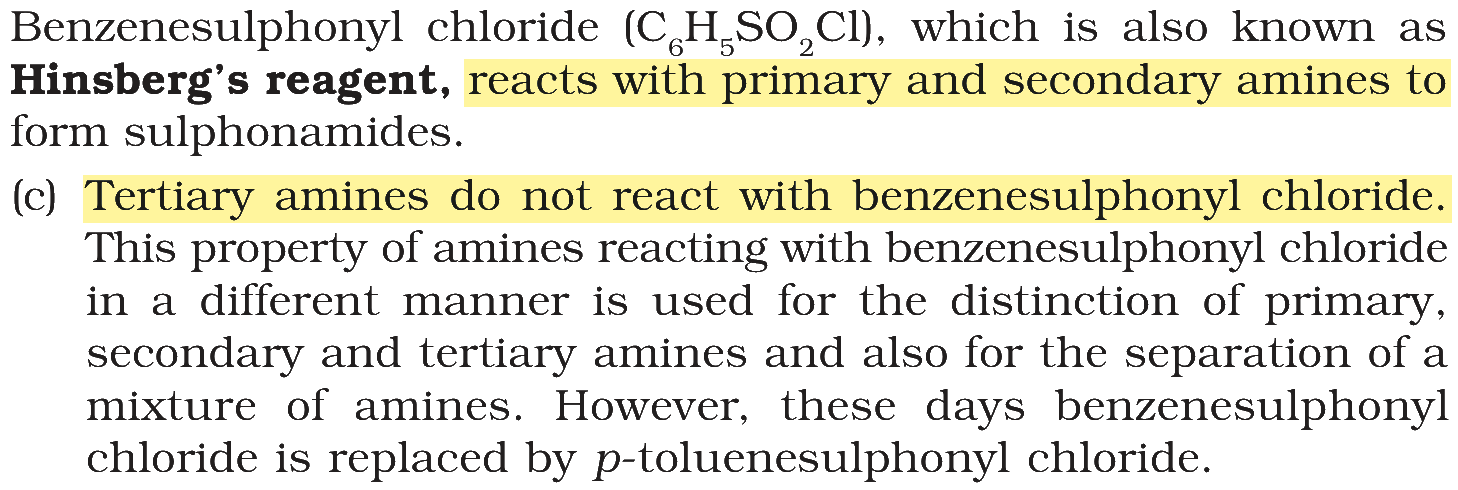
Hinsberg’s reagent is benzenesulphonyl chloride, \( \ce{C6H5SO2Cl} \). It replaces a hydrogen on the nitrogen of an amine by the \( \ce{C6H5SO2-} \) group, so it reacts only with amines that have an N–H bond. A primary amine gives a sulphonamide that still has an acidic N–H hydrogen and dissolves in alkali; a secondary amine gives one with no N–H hydrogen, insoluble in alkali; a tertiary amine does not react.
Option (1) Aniline — Responds (primary amine). \( \ce{C6H5NH2} \) gives N-phenylbenzenesulphonamide, soluble in alkali.
\( \displaystyle \ce{C6H5SO2Cl + H2N-C6H5 -> C6H5SO2NH-C6H5 + HCl} \)
Option (2) N-Methyl aniline — Responds (secondary amine). \( \ce{C6H5NHCH3} \) gives N-methyl-N-phenylbenzenesulphonamide, which has no N–H hydrogen and is insoluble in alkali.
\( \displaystyle \ce{C6H5SO2Cl + HN(CH3)C6H5 -> C6H5SO2N(CH3)C6H5 + HCl} \)
Option (3) N,N-Dimethyl aniline — Does not respond (tertiary amine). In \( \ce{C6H5N(CH3)2} \) the nitrogen carries no hydrogen, so there is nothing for the \( \ce{C6H5SO2-} \) group to replace.
Option (4) o-Toluidine — Responds (primary amine). 2-Methylaniline has its methyl group on the ring, not on nitrogen, so the –\( \ce{NH2} \) group reacts as in aniline.
NCERT (2026-27 edition):
Reaction with Arylsulphonyl Chloride