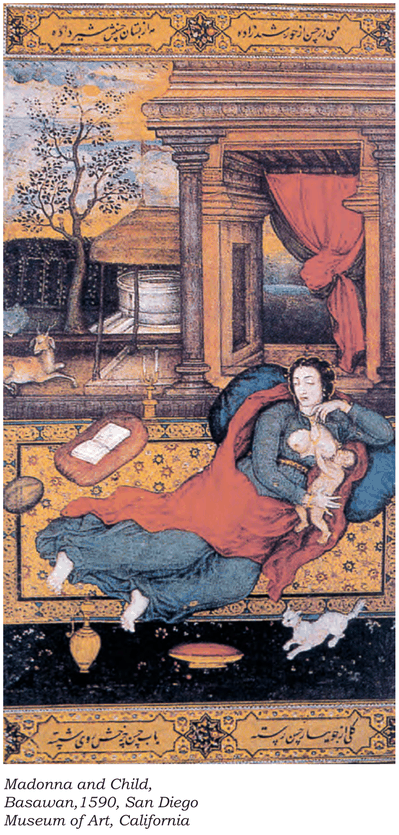
Consider the following statements about the Mughal painting Madonna and Child:
(A) It is done in opaque watercolour on paper.
(B) The mother-child attachment shown was inspired by the humanist interpretation in European Renaissance art.
(C) Virgin Mary is draped in a Persian manner.
(D) The physiology of the child and details like the fan and jewellery integrated the work to an Indian milieu.
(E) Its theme brings the Byzantine art, the European classical and its Renaissance to the Mughal atelier.
Choose the correct answer from the options given below:
Answer & explanation
Correct answer: option 2
The correct answer is Option (2) → (A), (B), (D) and (E) only
(A) It is done in opaque watercolour on paper. — Correct. It is an early work of the Mughal School in opaque watercolour on paper.
(B) The mother-child attachment shown was inspired by the humanist interpretation in European Renaissance art. — Correct. The bond between the two comes from the humanist reading in Renaissance art.
(C) Virgin Mary is draped in a Persian manner. — Incorrect. She is draped in a classical manner, not a Persian one.
(D) The physiology of the child and details like the fan and jewellery integrated the work to an Indian milieu. — Correct. These details place the European theme in an Indian milieu.
(E) Its theme brings the Byzantine art, the European classical and its Renaissance to the Mughal atelier. — Correct. The theme joins Byzantine, European classical and Renaissance art in the Mughal atelier.
NCERT (2026-27): “Early Mughal Painting …Madonna and Child … done in opaque watercolour on paper is an important early work of the Mughal School of Painting in this context. Madonna, here, is an extraordinary theme, which brings the Byzantine art, the European classical and its Renaissance to the Mughal atelier, where it is translated and transformed into an entirely different visual experience. Virgin Mary is draped in a classical manner. The attachment displayed between the mother and the child was inspired by the humanist interpretation in the European Renaissance art. The physiology of the child, certain details like the fan and jewellery completely integrated the work to an Indian milieu.”
|