Match List I with List II.
| List I | List II |
| (A) Dematerialisation | (I) A trading platform for fixed income securities |
| (B) Stock Exchange | (II) The process of holding securities in an electronic form |
| (C) Wholesale debt market | (III) Intermediary between investor and depository |
| (D) Depository participant | (IV) Spreading of equity cult |
Choose the correct answer from the options given below :
Answer & explanation
Correct answer: option 1
The correct answer is Option (1) → (A)-(II), (B)-(IV), (C)-(I), (D)-(III)
(A) Dematerialisation — this matches (II) The process of holding securities in an electronic form. Paper share certificates are cancelled and the investor holds the shares as an electronic balance in a demat account, much like money in a bank account.
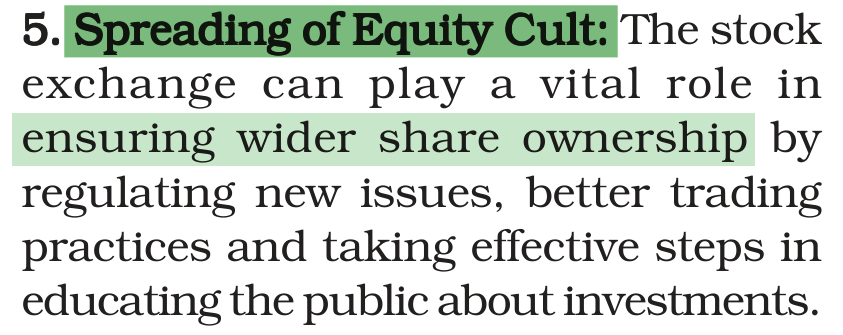
(B) Stock Exchange — this matches (IV) Spreading of equity cult. This is one of the functions of a stock exchange. By regulating new issues and teaching the public about investment, it spreads share ownership among more people.
(C) Wholesale debt market — this matches (I) A trading platform for fixed income securities. This segment of the National Stock Exchange trades securities that pay a fixed income, such as government securities, treasury bills, bonds and debentures.
(D) Depository participant — this matches (III) Intermediary between investor and depository. The investor cannot deal with the depository (NSDL or CDSL) directly. A bank, broker or financial company acting as a DP opens the demat account and links the two.
Note: Although the chapter ‘Financial Markets’ was dropped from the NCERT textbooks during rationalisation, it has stayed in the NTA syllabus every year since 2022, except for 2025, and it is part of the syllabus again from 2026. This question is therefore based on the pre-rationalised NCERT, an extract from which is given below. NCERT (Pre-rationalised Edition): “Dematerialisation and Depositories … This is a process where securities held by the investor in the physical form are cancelled and the investor is given an electronic entry or number so that she/he can hold it as an electronic balance in an account. This process of holding securities in an electronic form is called dematerialisation. …” “Whole Sale Debt Market Segment: This segment provides a trading platform for a wide range of fixed income securities that include central government securities, treasury bills, state development loans, bonds issued by public sector undertakings, floating rate bonds, zero coupon bonds, index bonds, commercial paper, certificate of deposit, corporate debentures and mutual funds.” “Depository … The depository participant (DP) serves as an intermediary between the investor and the Depository (NSDL or CSDL) who is authorised to maintain the accounts of dematerialised shares. …”
|