CUETMOCK
  • Pricing
  • Mentors
Log inStart freeStart free mocks→

First test, then trust

Try a free CUET mock test.

Join 5,00,000+ students who rehearsed exam day on the exact NTA screen before sitting CUET. On the web and on Android.

Start free mocks →Get the Android app
CUETMOCK

India's #1 CUET Mock Test Platform. Original NCERT-based questions on the exact NTA exam screen — trusted by 5,00,000+ students since CUET 2022.

Get it onGoogle PlayScan to download the CUETMOCK app

Mock tests

  • CUET mock test series
  • Browse all papers
  • Commerce mocks
  • Humanities (Arts) mocks
  • Science mocks
  • Languages & GAT mocks
  • Free practice questions
  • Pricing

Resources

  • CUET exam guide
  • CUET syllabus
  • Universities accepting CUET
  • Expert blogs
  • News & notifications
  • Webinars & counselling
  • CUET score calculator
  • How we estimate your rank
  • FAQs

Company

  • About us
  • Our leadership & team
  • Our toppers
  • Mentors
  • For schools
  • Contact us
  • Terms
  • Privacy
  • Refund policy

Talk to us

+91 7696 6630 56info@cuetmock.comWhatsApp us

Our other platforms

  • JEE Mock — For IIT-JEE aspirants
  • NEET Mock — For NEET aspirants

Newsletter

Exam updates, study material and offers — no spam.

© 2026 NYC Ventures Pvt. Ltd.

701-702, Royal Business Park, Zirakpur, Punjab - 140603

  • Terms of use
  • Privacy policy
  • Refund policy
  • Contact us

iCUETMOCK is an independent preparation platform, not affiliated with the National Testing Agency (NTA). Always check exam details on the official NTA website.

  • Home
  • Mock tests
  • CUET guide
  • Pricing
  • Log in
Home/Practice questions/Accountancy Part B
Accountancy Part BAccounting Ratios

Calculate 'Liquid Ratio' from the following information: Current liab…

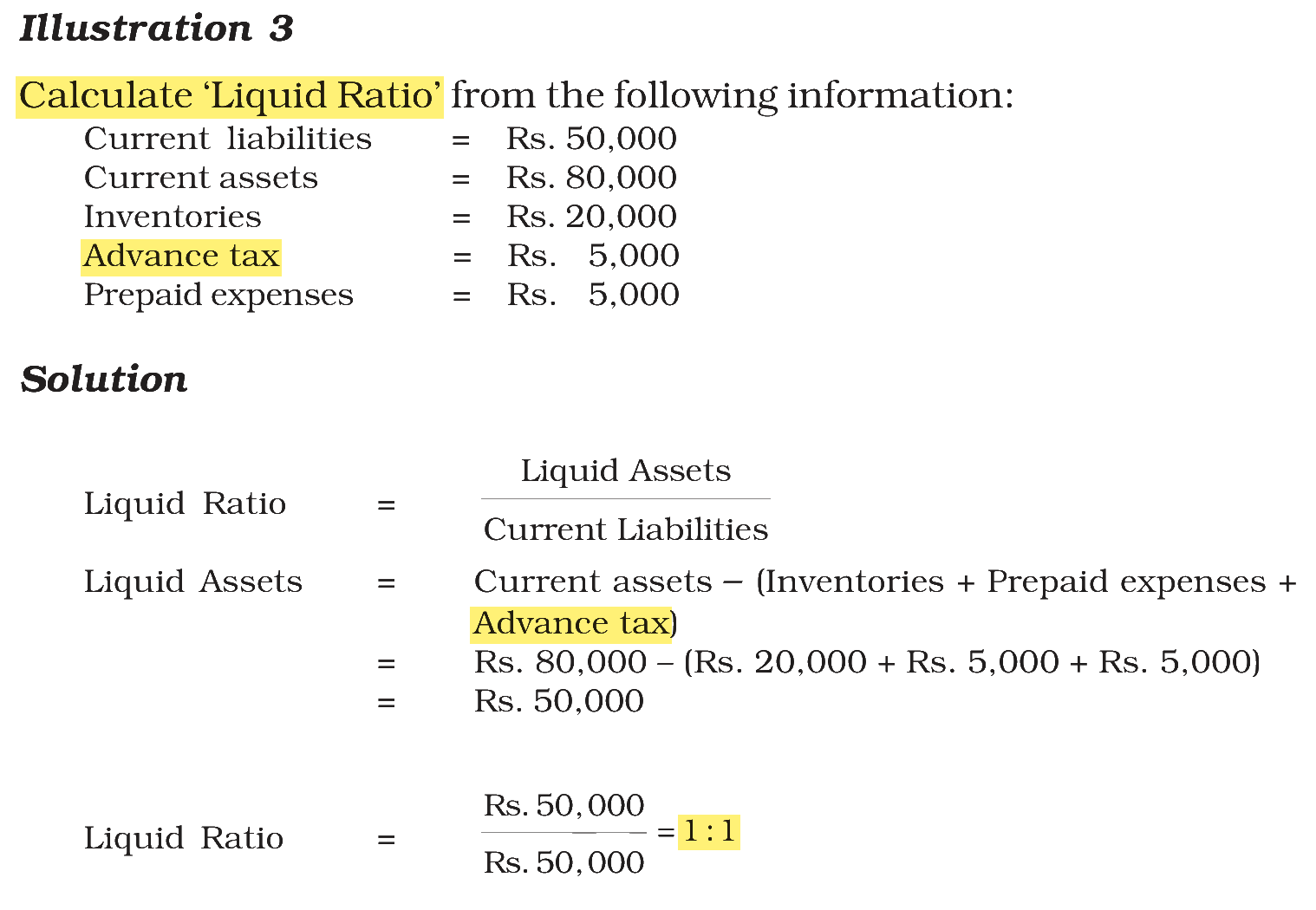
Calculate 'Liquid Ratio' from the following information:

Current liabilities

Rs. 50,000

Current assets

Rs. 80,000

Inventories

Rs. 20,000

Advance tax

Rs. 5,000

Prepaid expenses

Rs. 5,000

Answer & explanation+

Correct answer: option 3

The correct answer is Option (3) → 1:1

Liquid ratio = liquid assets / current liabilities. Liquid assets are the current assets that can quickly be turned into cash, so inventories, prepaid expenses and advance tax are taken out.

  • Liquid assets = 80,000 − (20,000 + 5,000 + 5,000) = Rs. 50,000

  • Liquid ratio = 50,000 / 50,000 = 1:1

Leaving advance tax or prepaid expenses inside the liquid assets gives 1.1:1 and is the common slip.

NCERT (2026-27 edition):
Liquidity Ratios

Extract from the NCERT textbook

Advertisement

Practise more on Accounting Ratios

Chapter-wise mocks on the real NTA exam screen, with solutions and your rank. Your first mocks are free.

Start free mocks →

Advertisement

Next questions

  1. 3.65 g of HCl is dissolved in 16.2 g of water. The mole fraction of HCl in the resulting solution is:Chemistry · Physical: Solutions
  2. Human activities like over cultivation, unrestricted grazing, deforestation and poor irrigation practices result into _____________.Biology · Environmental Issues
  3. The bar graph shows the number of members of a club from 2019 to 2023. By what percentage did the number of members increase from 2019 to 2…General Aptitude Test · Quantitative Reasoning
  4. Which of the following figure is odd one among the all.General Aptitude Test · General Ability
  5. Wavelength of matter wave is independent of:Physics · Dual Nature of Radiation and Matter
  6. Which one of the following industrial centres developed in India after Independence?Geography · India-People and Economy: Human Settlements
  7. Select the most appropriate one-word substitution for the given group of words. One who is easily duped or fooledEnglish · One Word
  8. Why the accounting treatment for the death of a partner is considered cumbersome?Accountancy · Reconstitution of Partnership Firm: Retirement and Death
  9. Which set of letters, when placed in order in the blanks of the given letter series, completes it? _ K K D _ K D K _ D _ KGeneral Aptitude Test · Verbal Reasoning
  10. A voltage signal is given as V = 10 sin 4 π t Volts. What will be the r.m.s. value of current passing through the circuit of resistance 50…Physics · Alternating Current