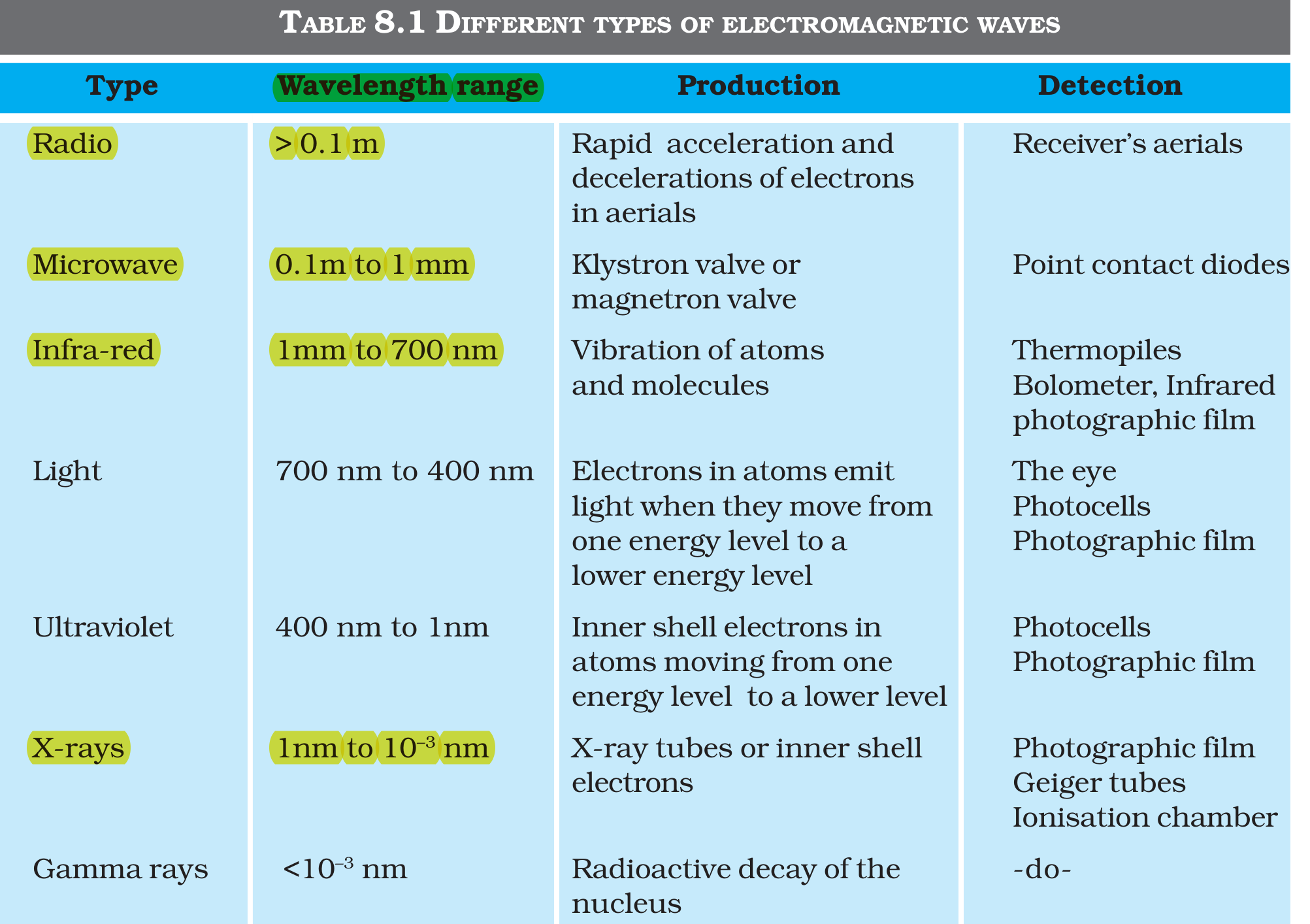
Match List-I with List-II
| List-I | List-II |
| (Electromagnetic waves) | (Wavelength range) |
| (A) X-rays | (I) 1 mm to 700 nm |
| (B) Radio waves | (II) 0.1 m to 1 mm |
| (C) Infrared waves | (III) 1 nm to \( 10^{-3} \) nm |
| (D) Microwaves | (IV) > 0.1 m |
Choose the correct answer from the options given below:
Answer & explanation
Correct answer: option 4
The correct answer is Option (4) → (A) - (III), (B) - (IV), (C) - (I), (D) - (II)
The electromagnetic spectrum, in order of decreasing wavelength, runs from radio waves through microwaves and infrared to X-rays and gamma rays.
(A) X-rays — this matches (III) 1 nm to \( 10^{-3} \) nm. X-rays have the shortest wavelengths of the four.
(B) Radio waves — this matches (IV) > 0.1 m. Radio waves have the longest wavelengths, above \( 0.1\,\mathrm{m} \).
(C) Infrared waves — this matches (I) 1 mm to 700 nm. Infrared lies just beyond the red end of visible light, which begins at about \( 700\,\mathrm{nm} \).
(D) Microwaves — this matches (II) 0.1 m to 1 mm. Microwaves lie between radio waves and infrared.
NCERT (2026-27):
Gamma Rays – …