
CUETMOCK
  • Pricing
  • Mentors
Log inStart freeStart free mocks→

First test, then trust

Try a free CUET mock test.

Join 5,00,000+ students who rehearsed exam day on the exact NTA screen before sitting CUET. On the web and on Android.

Start free mocks →Get the Android app
CUETMOCK

India's #1 CUET Mock Test Platform. Original NCERT-based questions on the exact NTA exam screen — trusted by 5,00,000+ students since CUET 2022.

Get it onGoogle PlayScan to download the CUETMOCK app

Mock tests

  • CUET mock test series
  • Browse all papers
  • Commerce mocks
  • Humanities (Arts) mocks
  • Science mocks
  • Languages & GAT mocks
  • Free practice questions
  • Pricing

Resources

  • CUET exam guide
  • CUET syllabus
  • Universities accepting CUET
  • Expert blogs
  • News & notifications
  • Webinars & counselling
  • CUET score calculator
  • How we estimate your rank
  • FAQs

Company

  • About us
  • Our leadership & team
  • Our toppers
  • Mentors
  • For schools
  • Contact us
  • Terms
  • Privacy
  • Refund policy

Talk to us

+91 7696 6630 56info@cuetmock.comWhatsApp us

Our other platforms

  • JEE Mock — For IIT-JEE aspirants
  • NEET Mock — For NEET aspirants

Newsletter

Exam updates, study material and offers — no spam.

© 2026 NYC Ventures Pvt. Ltd.

701-702, Royal Business Park, Zirakpur, Punjab - 140603

  • Terms of use
  • Privacy policy
  • Refund policy
  • Contact us

iCUETMOCK is an independent preparation platform, not affiliated with the National Testing Agency (NTA). Always check exam details on the official NTA website.

  • Home
  • Mock tests
  • CUET guide
  • Pricing
  • Log in
Home/Practice questions/Physics
PhysicsElectrostatic Potential and Capacitance

A small charged particle of mass m and charge q is suspended by an in…

A small charged particle of mass m and charge q is suspended by an insulated thread in front of a very large sheet of charge density σ. The angle made by the thread with the vertical in equilibrium is
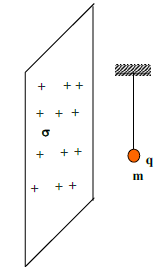
Answer & explanation+

Correct answer: option 1

In equilibrium, along x-axis,

T sin θ = qE
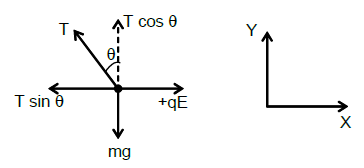
⇒ T sin θ = q$\frac{σ}{2ε_0}$          . . . (1)

Where T is the tension in the string.

Along y-axis in equilibrium, T cos θ = mg      . . . (2)

From (1) and (2) we obtain,

$\tan \theta=\frac{q \sigma}{2 \varepsilon_0 mg} \Rightarrow \theta=\tan ^{-1}\left(\frac{\sigma q}{2 \varepsilon_0 mg}\right)$

∴  (A)

Advertisement

Practise more on Electrostatic Potential and Capacitance

Chapter-wise mocks on the real NTA exam screen, with solutions and your rank. Your first mocks are free.

Start free mocks →

Advertisement

Next questions

  1. Choose the most appropriate ANTONYM of the given word. RELUCTANTLYEnglish · Antonyms
  2. Match List-I with List-II List-I List-II (A) Fermentation of glucose (I) Invertase (B) Methanol (II) Zymase (C) Ethanol (III) Poisonous eve…Chemistry · Organic: Alcohols, Phenols and Ethers
  3. In Sri Lanka, Sinhala language is the official language. This example reflects which kind of policy?Sociology · Indian Society: Challenges of Cultural Diversity
  4. In public subscription, when there is no articles of association, which of the following provision is not true?Accountancy Part A · Accounting for Shares
  5. Two separate light bulbs are used as the two sources in an interference experiment. Which of the following is correct?Physics · Wave Optics
  6. Out of the options select the one which best expresses the following sentence in Indirect Speech: The daughter said to her mother, "They ha…English · Direct/indirect
  7. Haemodialysis is a treatment that does the work of which organs when they fail?General Aptitude Test · General Knowledge
  8. Any behaviour by one person/ persons that is intended to cause harm to another person/persons would be known as?Psychology · Psychology and Life
  9. What is the percentage of oxygen in the atmosphere ?General Aptitude Test · General Knowledge
  10. If y = y(x) is the solution of the differential equation displaystyledy/dx = x(1 + y^2) satisfying y(0) = 1 , then the value of y at x = √(…Maths. Section A · Differential Equations (Section A)