Nucleophiles such as ammonia and its derivatives, \(H_2N-Z\), add to the carbonyl group of aldehydes and ketones. The reaction is reversible and catalysed by acid. The equilibrium favours product formation due to rapid dehydration of the intermediate to form \(-C=N-Z\), where Z = alkyl, aryl, OH, NH2, C6H5NH, NHCONH2, etc.
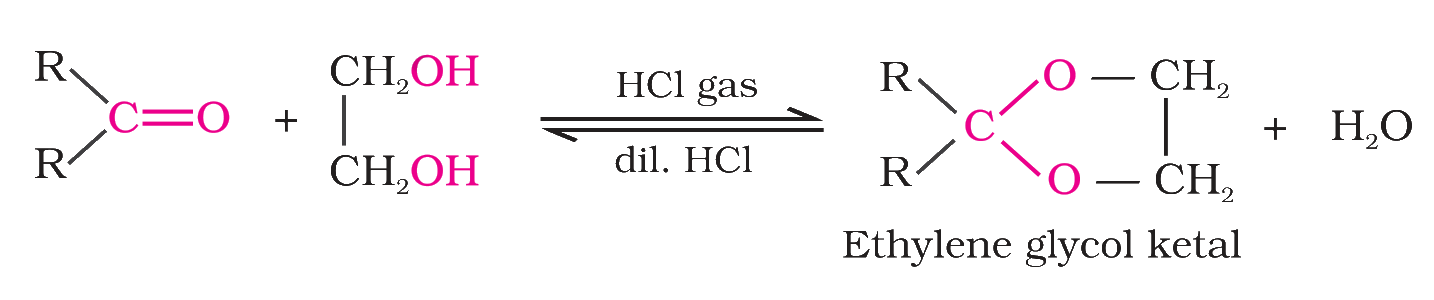
Like ammonia derivatives, alcohols also add to the carbonyl group. What type of product is formed when a ketone reacts with ethylene glycol in the presence of dry hydrogen chloride?
Answer & explanation
Correct answer: option 1
The correct answer is Option (1) → A cyclic ethylene glycol ketal
Ethylene glycol has two –OH groups. Both add to the same carbonyl carbon of the ketone, a molecule of water is lost, and a five-membered ring containing two oxygen atoms is formed. This cyclic product is an ethylene glycol ketal.
Dry hydrogen chloride protonates the carbonyl oxygen, which makes the carbonyl carbon more electrophilic and helps the weak nucleophile (the alcohol) to attack.
The ketal is hydrolysed back to the ketone by aqueous mineral acid.
Why the other options are incorrect
Option (2) A hemiacetal — Incorrect. A hemiacetal (an alkoxyalcohol) is the intermediate formed when an aldehyde reacts with one equivalent of a monohydric alcohol; with a diol, the ketone goes on to the cyclic ketal.
Option (3) A ketol (β-hydroxy ketone) — Incorrect. A ketol is formed when two molecules of a ketone with an α-hydrogen join in the aldol reaction, with dilute alkali as catalyst, not with an alcohol and HCl.
Option (4) A secondary alcohol — Incorrect. A ketone gives a secondary alcohol on reduction, for example with NaBH4 or LiAlH4. Ethylene glycol is not a reducing agent.
NCERT (2026-27 edition):
8.4 Chemical Reactions – “Ketones react with ethylene glycol under similar conditions to form cyclic products known as ethylene glycol ketals. Dry hydrogen chloride protonates the oxygen of the carbonyl compounds and therefore, increases the electrophilicity of the carbonyl carbon facilitating the nucleophilic attack of ethylene glycol. Acetals and ketals are hydrolysed with aqueous mineral acids to yield corresponding aldehydes and ketones respectively.”