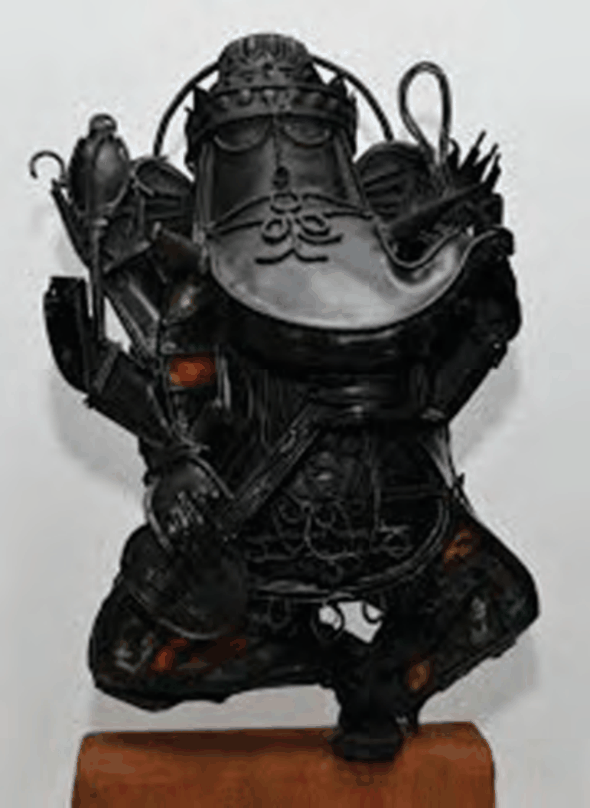
Observe the sculpture and read the passage about it. In this sculpture, Ganesha is playing vina, a musical instrument. Details on the sculpture and technical blending of material, nevertheless, reveal the artist’s meticulous craftsmanship. The artist also experimented with the ‘open-endedness’ quality of indigenous workmanship. The sculpture reveals his understanding of traditional imagery. Rhythm and growth are incorporated through lyrical stylisation. It is also an amalgamation of folk and traditional craftsmanship.
In terms of form, how is the sculpture conceived?
Answer & explanation
Correct answer: option 4
The correct answer is Option (4) → In terms of linear silhouettes
Option (1) With emphasis on three-dimensionality — Incorrect. The form is conceived in silhouettes instead of an emphasis on three-dimensionality, even though the sculpture has volume.
Option (2) With ornate contours that give a touch of puppets — Incorrect. This describes Laxma Goud’s etching Rural South Indian Man–Woman, whose ornate contours give a touch of puppets to the figures.
Option (3) As wiry forms between abstraction and figure — Incorrect. This fits Amarnath Sehgal, who struck a balance between abstraction and figurative in wiry sculptures like Cries Unheard.
Option (4) In terms of linear silhouettes — Correct. Janakiram’s Ganesha is conceived in terms of linear silhouettes, even though the sculpture has volume.
NCERT (2026-27): “Ganesha This is a sculpture in oxidised copper made by P. V. Janakiram in 1970, and is in the collection of NGMA, Delhi. He has used sheets of copper to create pictorial sculpture as free-standing forms, and ornamented their surface with linear elements. Metal sheets are beaten into concave planes on which are welded linear details. … He has elaborated linear details into overall form. The sculpture is conceived in terms of linear silhouettes instead of emphasis on three-dimensionality, despite its volume.”
|