
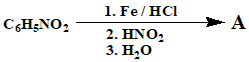
Product (A) is:
Answer & explanation
Correct answer: option 2
The correct answer is Option (2) → C6H5OH
The sequence converts a nitro group into an –OH group through a diazonium salt. First, Fe/HCl reduces nitrobenzene to aniline:
\( \displaystyle \ce{C6H5NO2 + 6[H]} \xrightarrow{\ce{Fe/HCl}} \ce{C6H5NH2 + 2H2O} \)
Next, nitrous acid (made from \( \ce{NaNO2} \) and HCl at 273–278 K) diazotises aniline:
\( \displaystyle \ce{C6H5NH2 + HNO2 + HCl} \xrightarrow{\text{273-278 K}} \ce{C6H5N2^+Cl^- + 2H2O} \)
Then, on warming with water, the diazonium salt is hydrolysed to phenol and nitrogen escapes:
\( \displaystyle \ce{C6H5N2^+Cl^- + H2O} \xrightarrow{\Delta} \ce{C6H5OH + N2 + HCl} \)
So A is phenol.
Option (1) C6H5NO2 — Incorrect. This is the starting material; it is reduced in the very first step.
Option (3) m-NO2C6H4NH2 — Incorrect. m-nitroaniline would need nitration of the ring; no nitrating mixture is used, and the nitro group is reduced, not retained.
Option (4) C6H5NH2 — Incorrect. Aniline is only the product of the first step; \( \ce{HNO2} \) and water convert it further to phenol.
NCERT (2026-27 edition):
Replacement by Hydroxyl Group
