
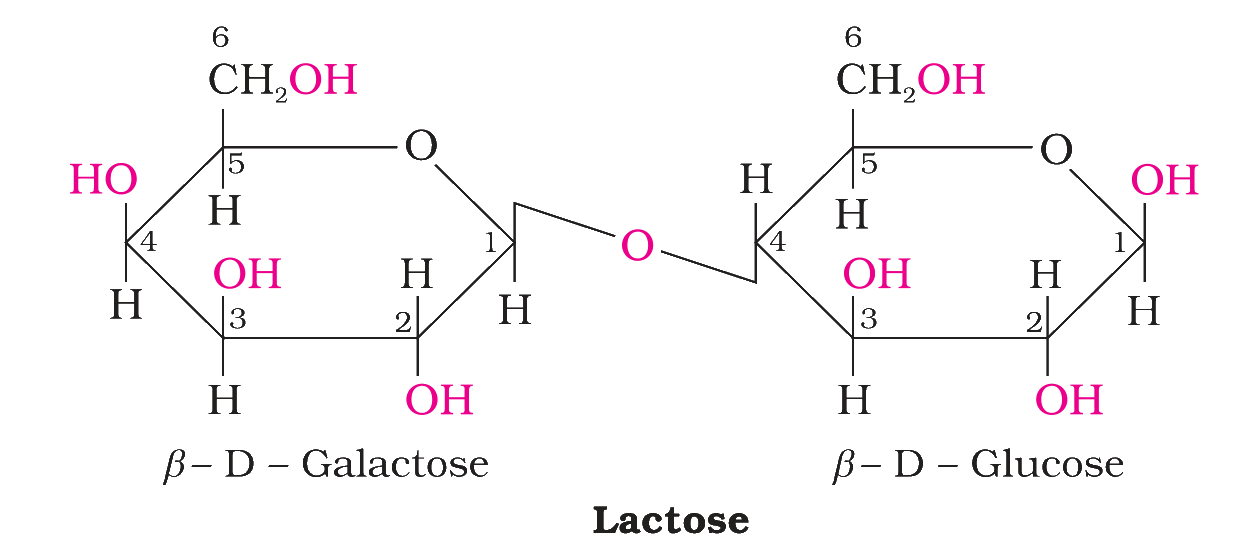
The figure shows the Haworth structure of lactose.
The glycosidic linkage in lactose joins which carbon atoms of its two monosaccharide units?
Answer & explanation
Correct answer: option 2
The correct answer is Option (2) → C1 of galactose and C4 of glucose
A glycosidic linkage joins two monosaccharide units through an oxygen atom. In the figure, the left ring is β-D-galactose and the right ring is β-D-glucose.
Following the bridging oxygen — the oxygen between the rings is bonded to the carbon numbered 1 of the galactose unit, and on the other side to the carbon numbered 4 of the glucose unit.
Why the other options are incorrect
Option (1) C1 of glucose and C4 of galactose — Incorrect. This reverses the units. C4 of galactose and C1 of glucose each carry a free –OH group; neither is bonded to the bridging oxygen.
Option (3) C1 of galactose and C1 of glucose — Incorrect. C1 of the glucose unit, at the right end of the figure, carries a free –OH group and H.
Option (4) C1 of galactose and C6 of glucose — Incorrect. C6 of the glucose unit is the free CH2OH group above the ring.
NCERT (2026-27 edition):
10.1.3 Disaccharides – “The two monosaccharides are joined together by an oxide linkage formed by the loss of a water molecule. Such a linkage between two monosaccharide units through oxygen atom is called glycosidic linkage.”
“(iii) Lactose: It is more commonly known as milk sugar since this disaccharide is found in milk. It is composed of β-D-galactose and β-D-glucose. The linkage is between C1 of galactose and C4 of glucose.”
Lactose