
Case: Read the passage and answer the question.
Consider a coil C1 connected to a galvanometer G as shown. A bar magnet is placed near the coil with its North pole facing the coil and its South pole away from it. The magnet is then moved towards the coil.
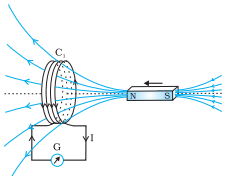
Answer the following question in this context.
The magnet is now held fixed, and the coil C1 is moved towards its North pole. The galvanometer
Answer & explanation
Correct answer: option 3
The correct answer is Option (3) → deflects in the same direction as when the magnet was moved towards the coil
An emf is induced in the coil whenever the flux through it changes. For this, only the relative motion of the magnet and the coil matters.
Option (1) shows no deflection, because the magnet is at rest — Incorrect. The coil moves into the stronger field near the pole, so the flux through it still increases. An emf is induced even though the magnet is at rest.
Option (2) deflects in the direction opposite to that seen when the magnet was moved towards the coil — Incorrect. In both cases the North pole and the coil come closer, and the flux through the coil increases in the same way. A reversed deflection needs them to move apart.
Option (3) deflects in the same direction as when the magnet was moved towards the coil — Correct. Moving the coil towards the North pole changes the flux in the same way as moving the pole towards the coil. So the current, and the deflection, are in the same direction.
Option (4) deflects in a direction that depends on how fast the coil is moved — Incorrect. The speed changes only the size of the deflection. The direction depends on whether the flux through the coil increases or decreases.
NCERT (2026-27):
The Experiments of Faraday and Henry – “… Instead, when the bar magnet is held fixed and the coil C1 is moved towards or away from the magnet, the same effects are observed. It shows that it is the relative motion between the magnet and the coil that is responsible for generation (induction) of electric current in the coil.”