CUETMOCK
  • Pricing
  • Mentors
Log inStart freeStart free mocks→

First test, then trust

Try a free CUET mock test.

Join 5,00,000+ students who rehearsed exam day on the exact NTA screen before sitting CUET. On the web and on Android.

Start free mocks →Get the Android app
CUETMOCK

India's #1 CUET Mock Test Platform. Original NCERT-based questions on the exact NTA exam screen — trusted by 5,00,000+ students since CUET 2022.

Get it onGoogle PlayScan to download the CUETMOCK app

Mock tests

  • CUET mock test series
  • Browse all papers
  • Commerce mocks
  • Humanities (Arts) mocks
  • Science mocks
  • Languages & GAT mocks
  • Free practice questions
  • Pricing

Resources

  • CUET exam guide
  • CUET syllabus
  • Universities accepting CUET
  • Expert blogs
  • News & notifications
  • Webinars & counselling
  • CUET score calculator
  • How we estimate your rank
  • FAQs

Company

  • About us
  • Our leadership & team
  • Our toppers
  • Mentors
  • For schools
  • Contact us
  • Terms
  • Privacy
  • Refund policy

Talk to us

+91 7696 6630 56info@cuetmock.comWhatsApp us

Our other platforms

  • JEE Mock — For IIT-JEE aspirants
  • NEET Mock — For NEET aspirants

Newsletter

Exam updates, study material and offers — no spam.

© 2026 NYC Ventures Pvt. Ltd.

701-702, Royal Business Park, Zirakpur, Punjab - 140603

  • Terms of use
  • Privacy policy
  • Refund policy
  • Contact us

iCUETMOCK is an independent preparation platform, not affiliated with the National Testing Agency (NTA). Always check exam details on the official NTA website.

  • Home
  • Mock tests
  • CUET guide
  • Pricing
  • Log in
Home/Practice questions/Economics
EconomicsMacro Economics: Government Budget and Economy

GST (Goods and Service Tax) is mainly consumption based tax with one…

Read the passage given below and answer the question.

GST : One Nation, One Tax, One Market

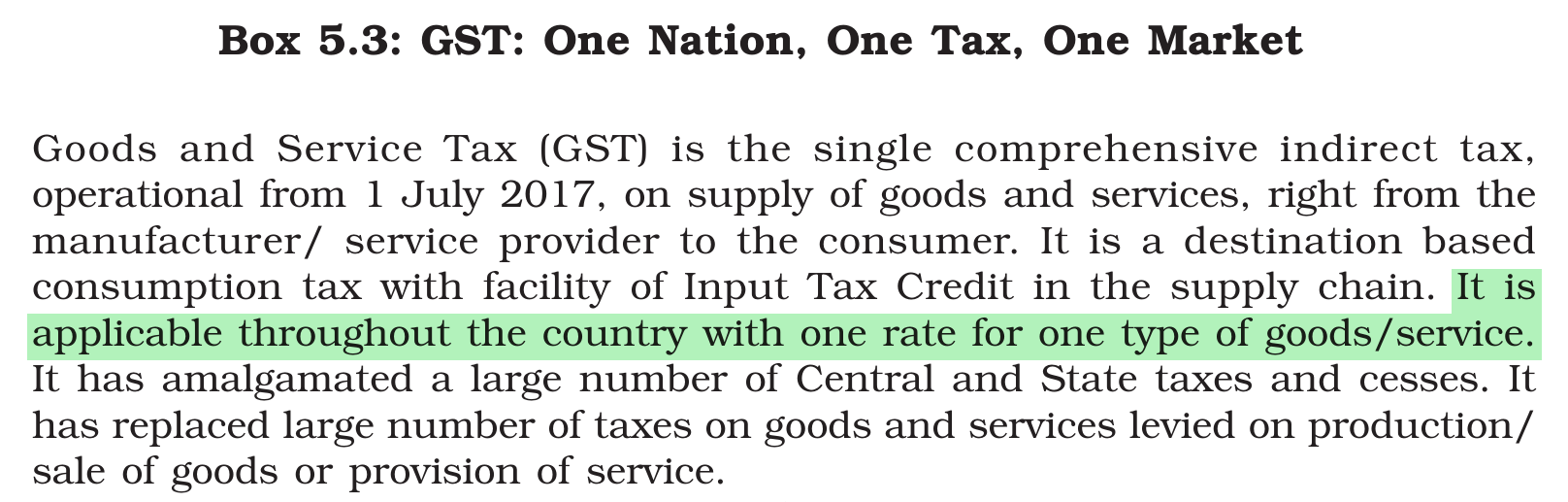
Goods and Service Tax (GST) is the single comprehensive indirect tax, operational from 1 July 2017, on supply of goods and services, right from the manufacturer/service provider to the consumer. It is a destination based consumption tax with facility of Input Tax Credit in the supply chain. It is applicable throughout the country with one rate for one type of goods/service. It has amalgamated a large number of Central and State taxes and cesses. It has replaced large number of taxes on goods and services levied on production/sale of goods or provision of service.

As there have been a number of intermediate goods/services, which were manufactured/ provided in the economy, the pre GST tax regime imposed taxes not on the value added at each stage but on the total value of the commodity/service with minimal facility of utilisation of Input Tax.

Credit (ITC) : The total value included taxes paid on intermediate goods/services. This amounted to cascading of tax. Under GST, the tax is discharged at every stage of supply and the credit of tax paid at the previous stage is available for set off at the next stage of supply of goods and/or services. It is thus effectively a tax on value addition at each stage of supply. In view of our large and fast growing economy, it addresses to establish parity in taxation across the country and extend principles of 'value-added taxation' to all goods and services.

It has replaced various types of taxes/cesses, levied by the Central and State/UT Governments. Some of the major taxes that were levied by Centre were Central Excise Duty, Service Tax, Central Sales Tax, Cesses like KKC and SBC. The major State taxes were VAT/Sales Tax, Entry Tax, Luxury Tax, Octroi, Entertainment Tax, Taxes on Advertisements, Taxes on Lottery/ Betting/Gambling, State Cesses on goods etc. These have been subsumed in GST.

Five petroleum products have been kept out of GST for the time being but with passage of time, they will get subsumed in GST. State Governments will continue to levy VAT on alcoholic liquor for human consumption. Tobacco and tobacco products will attract both GST and Central Excise Duty. Under GST, there are 6 (six) standard rates applied i.e. 0%, 3%, 5%, 12%, 18% and 28% on supply of all goods and/or services across the country.

GST (Goods and Service Tax) is mainly consumption based tax with one main principle which is :

Answer & explanation+

Correct answer: option 3

The correct answer is Option (3) → One rate for one type of goods/services

GST is applicable throughout the country with one rate for one type of goods/service. So the same good carries the same GST rate in every state.

This is the idea behind the name “One Nation, One Tax, One Market”.

NCERT (2026-27): Introductory Macroeconomics — Chapter 5: Government Budget and the Economy

NCERT extract

Advertisement

Practise more on Macro Economics: Government Budget and Economy

Chapter-wise mocks on the real NTA exam screen, with solutions and your rank. Your first mocks are free.

Start free mocks →

Advertisement

Next questions

  1. Which of the following are examples of Knowledge Processing outsourcing (KPO) ?Geography · Fundamentals of Human Geography: Tertiary and Quaternary Activities
  2. Select the correctly spelt word.English · Spelling Check
  3. Which of the following statements is true regarding the nature of Principles of Management?Business Studies · Principles of Management
  4. Why is the ‘raising of viscosity’ of a solution after the addition of solute, not considered to be a colligative property?Chemistry · Physical: Solutions
  5. The coil in an AC generator is mounted on an axle and is rotated. What can we say about the rotation?Physics · Electromagnetic Induction
  6. निम्नलिखित में से कौन-सा विलोम युग्म नहीं है?Hindi · विलोम शब्द
  7. Select the Venn diagram that best represents the relationship between the following classes.Planets, Mars, JupiterGeneral Aptitude Test · Verbal Reasoning
  8. In the event of the death of a partner in a firm, the payments due to the deceased partner is made to which account?Accountancy · Reconstitution of Partnership Firm: Retirement and Death
  9. The mosque Aamir saw is often regarded as the jewel in the crown of the existing mosques of Kashmir. Which of the following is correct abou…History · Medieval India: Bhakti Sufi Traditions
  10. 'जलियाँवाला बाग में वसंत' इस रचना के रचनाकार हैं-Hindi · हिंदी साहित्य (रचना, रचनाकार और विधाएँ)