
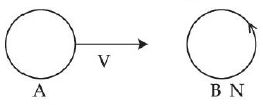
There are two coils A and B. Current is induced in B as shown when A moves towards B. No current flows through B when A stops. What is the direction of current in A.
Answer & explanation
Correct answer: option 4
The correct answer is Option (4) → There is a constant current in anticlockwise direction in A.
A current is induced in B only when the magnetic flux through B changes (Faraday's law), and its direction opposes that change (Lenz's law).
When A stops, no current flows in B. So the flux of A through B is then constant, which means the current in A is constant. A varying current in A would induce a current in B even with A at rest. A current must still exist in A, because moving A towards B does induce a current in B.
As A approaches, the flux of A through B increases. By Lenz's law, B's induced current must oppose this increase, so it circulates in the sense opposite to the current in A. Reversing the sense of the induced current shown in B gives the current in A: anticlockwise.
NCERT (2026-27):
The Experiments of Faraday and Henry – “… In Fig. 6.2 the bar magnet is replaced by a second coil C2 connected to a battery. The steady current in the coil C2 produces a steady magnetic field. As coil C2 is moved towards the coil C1, the galvanometer shows a deflection. … The deflection lasts as long as coil C2 is in motion.”