
Which of the following reactions will give n-Propanol as a product?
(A) Hydroboration oxidation of Propene
(B) Reduction of propanal with Palladium as a catalyst
(C) Reaction of Formaldehdye with Ethylmagnesium bromide followed by hydrolysis
(D) Acid catalyzed hydration of propene
Choose the correct answer from the options given below:
Answer & explanation
Correct answer: option 2
The correct answer is Option (2) → (A), (B) and (C) only
n-Propanol ($CH_{3}CH_{2}CH_{2}OH$) is a primary alcohol. Each reaction must be checked to see whether it forms this compound.
Analysis of the Statements
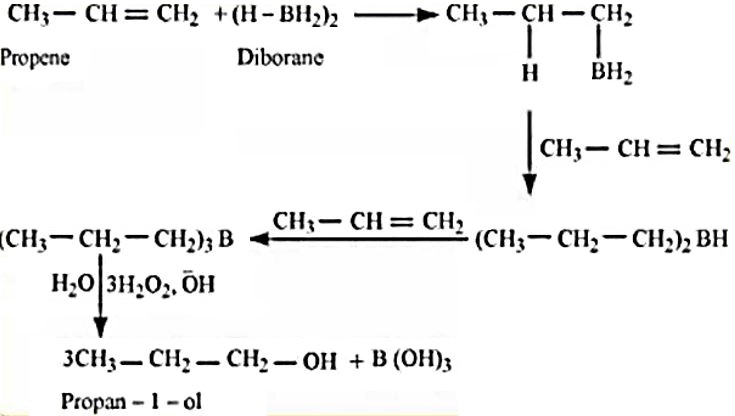
(A) Hydroboration–oxidation of propene
Hydroboration–oxidation proceeds through anti-Markovnikov addition, where the $OH$ group attaches to the less substituted carbon of the double bond.
Reaction:
$CH_{3}-CH=CH_{2} \rightarrow CH_{3}-CH_{2}-CH_{2}OH$
Product formed: n-Propanol
Thus, statement (A) is correct.
(B) Reduction of propanal
Propanal is an aldehyde. Reduction of aldehydes using hydrogen with catalysts such as Pd, Pt, or Ni converts them into primary alcohols.
Reaction:
$CH_3CH_2CHO \rightarrow CH_3CH_2CH_2OH$
Product formed: n-Propanol
Thus, statement (B) is correct.

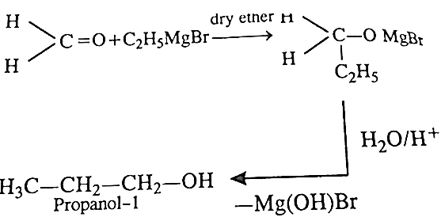
(C) Reaction of formaldehyde with ethylmagnesium bromide
Grignard reagents react with formaldehyde to produce primary alcohols with one additional carbon atom.
Reaction:
$HCHO + C_2H_5MgBr \rightarrow CH_3CH_2CH_2OH$ (after hydrolysis)
Product formed: n-Propanol
Thus, statement (C) is correct.
(D) Acid catalyzed hydration of propene
Acid-catalyzed hydration follows Markovnikov addition. The OH group attaches to the more substituted carbon, producing:
$CH_3-CHOH-CH_3$
Product formed: 2-propanol, not n-propanol.
Thus, statement (D) is incorrect.