
The incorrect equation for Arrhenius equation for activation energy is:
Answer & explanation
Correct answer: option 2
The correct answer is option 2. \(log k = -\frac{E_a}{2.303R}\frac{1}{T × log A}\).
Most of the chemical reactions are accelerated by increase in temperature. It has been found that for a chemical reaction with rise in temperature by 10°, the rate constant is nearly doubled.
The effect of temperature on the rate of a reaction and hence on the rate constant k, was proposed by Arrhenius (1889). The equation is called Arrhenius equation, is usually written in the form
\(k = Ae^{-E_a/RT} -------(i)\)
where,
the pre-exponential factor, \(A\) is a constant and is called frequency factor (because it gives the frequency of binary collisions and the reacting molecules per second per litre),
\(E_a\) is the energy of activation,
\(R\) is gas constant
\(T\) is the absolute temperature
The two quantities ‘\(E_a\)’ and ‘\(A\)’ are together called Arrhenius parameters. The energy of activation \((E_a)\) is an important quantity as it is characteristic of the reaction. Using the above equation its value can be calculated
Taking logarithm on both sides of equation (i), we get
\(ln k = ln\left(Ae^{-E_a/RT}\right)\)
\(⇒ ln k = ln A + ln \left(e^{-E_a/RT}\right)\)
\(⇒ ln k = ln A + \left(\frac{-E_a}{RT}\right)\)
\(∴ ln k = ln A - \frac{E_a}{RT} --------(ii)\)
If the value of the rate constant at temperature \(T_1\) and \(T_2\) are \(k_1\) and \(k_2\) respectively, then we have
\(ln k_1 = ln A - \frac{E_a}{RT_1} --------(iii)\)
and \(ln k_2 = ln A - \frac{E_a}{RT_2} --------(iv)\)
Subtracting equation (iii) from equation (iv), we get
\(ln k_2 - ln k_1 = -\frac{E_a}{RT_2} - \left(-\frac{E_a}{RT_1}\right)\)
\(⇒ ln \frac{k_2}{k_1} = \frac{E_a}{RT_1} - \frac{E_a}{RT_2}\)
\(⇒ ln \frac{k_2}{k_1} = \frac{E_a}{R}\left[\frac{1}{T_1} - \frac{1}{T_2}\right]\)
\(⇒ ln \frac{k_2}{k_1} = \frac{E_a}{R}\left[\frac{T_2 - T_1}{T_1T_2}\right]\)
\(∴ log \frac{k_2}{k_1} = \frac{E_a}{2.303R}\left[\frac{T_2 - T_1}{T_1T_2}\right] -------(v)\)
Thus, knowing the values of rate constants \(k_1\) and \(k_2\) at two different temperatures \(T_1\) and \(T_2\), the value of \(E_a\) can be calculated. Alternatively, knowing the rate constant at any one temperature, its value at another temperature can be calculated provided the value of \(E_a\) is known for that reaction.
To test the validity of Arrhenius equation, let us consider equation (ii). It may be written as
\(ln k = -\frac{E_a}{RT} + ln A --------(vi)\)
or, \(log k = -\frac{E_a}{2.303}RT + log A ------(vii)\)
The equation (vii) is in the form \(y = mx + c\), i.e., the equation of a straight line. Thus, if a plot of \(log k\) vs \(\frac{1}{T}\) is a straight line, the validity of the equation is confirmed.
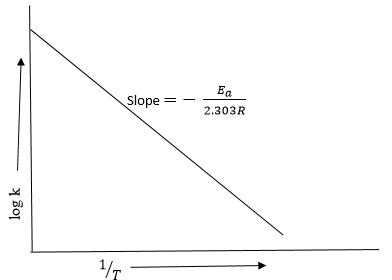
Thus, option 1 is given by equation (ii), option 3 is given by equation (v) and option 4 is given by (vii).