The electrode potential becomes equal to the standard electrode potential when the reactants and products concentration ratio is
Answer & explanation
Correct answer: option 1
The correct answer is Option (1) → equal to 1
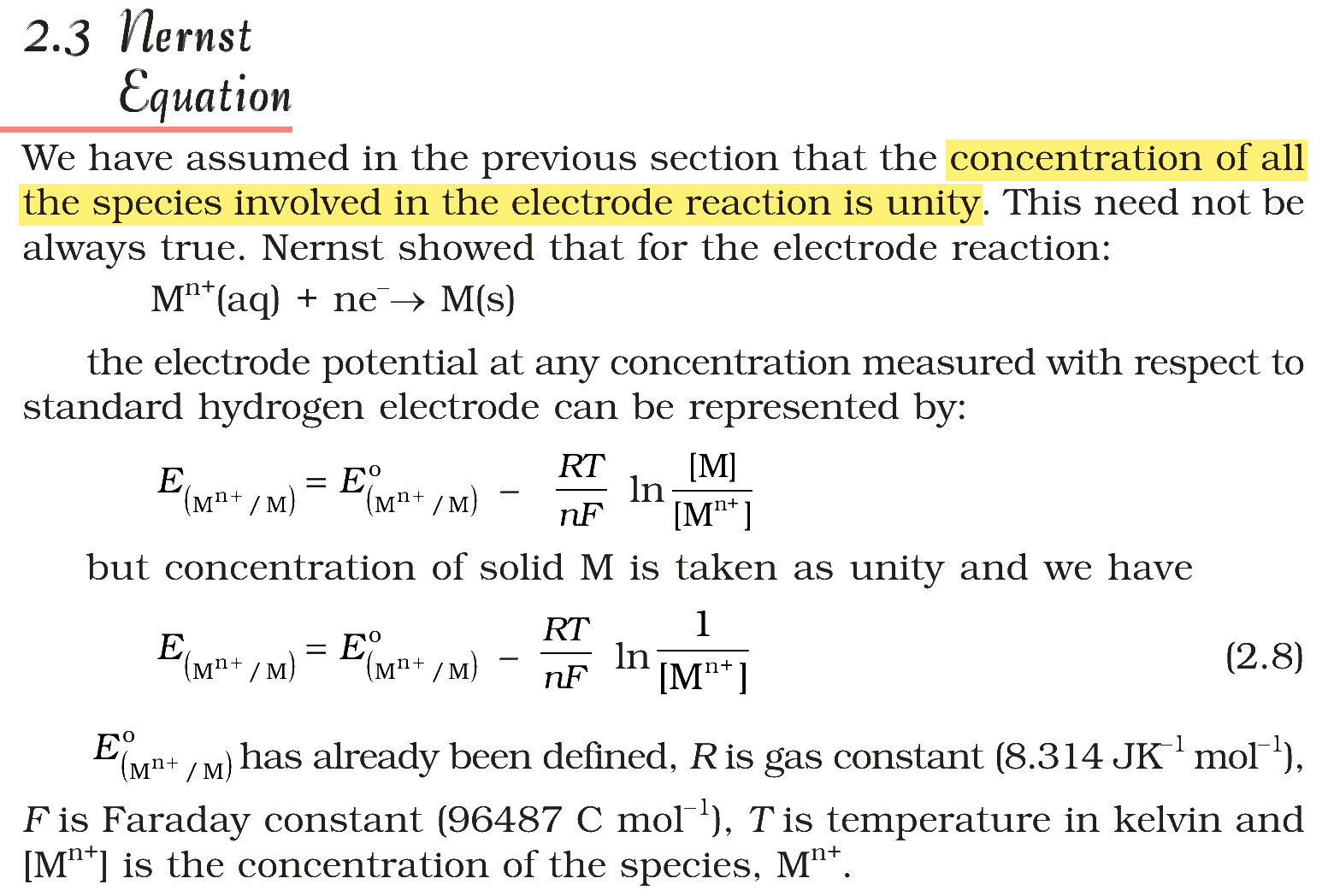
The standard electrode potential (E°) is the electrode potential when every species in the electrode reaction is at unit concentration. At any other concentration the electrode potential (E) is given by the Nernst equation. For the general reduction \( \ce{aA + bB + ne^- -> cC + dD} \):
\( \displaystyle E=E^{\circ}-\frac{RT}{nF}\ln\frac{[C]^c[D]^d}{[A]^a[B]^b} \)
E differs from E° only by the log term. When the concentration ratio of products to reactants is 1, that term vanishes:
\( \displaystyle \ln 1=0 \quad\Rightarrow\quad E=E^{\circ} \)
So the electrode potential equals the standard electrode potential when the concentration ratio is equal to 1. The ratio of reactants to products is then also 1. For a metal electrode \( \ce{M^{n+} + ne^- -> M} \), the solid is taken as unity, and this happens when \( [\ce{M^{n+}}] \) is 1 M.
Why the other options are incorrect
Option (2) greater than 1 — Incorrect. If the ratio of reactants to products is greater than 1, the products-to-reactants ratio in the log term is less than 1, the log term is negative, and E is more positive than E°.
Option (3) less than 1 — Incorrect. If the ratio of reactants to products is less than 1, the log term is positive, and E is less positive than E°.
NCERT (2026-27 edition):
Nernst Equation