
A cell is a source of electric current in the electrical circuit. The Potential difference between terminals of a cell in an open circuit (when no current is drawn) is called electromotive force (emf) of the cell. When electrical circuit is closed and current is drawn from the terminal potential difference between two terminals is called terminal potential difference (v) of the cell. The cells can be connected in series as well as in parallel combinations. Like resistor cell also offers opposition to the flow of current. This opposition offered by cell is called internal resistance of the cell.
The variation of terminal potential difference of a cell with current drawn from the cell is correctly represented by:
Answer & explanation
Correct answer: option 3
The correct answer is Option (3)
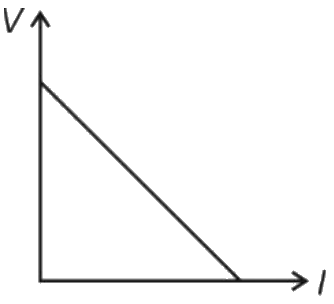
When a current \( I \) is drawn, part of the emf is used up across the internal resistance, so the terminal potential difference is
\( \displaystyle V = \varepsilon - I r \)
This is a straight line with negative slope \( -r \).
\( \text{At } I = 0: \ V = \varepsilon \ (\text{intercept on the } V\text{-axis}) \)
\( \text{At } V = 0: \ I = \varepsilon / r \ (\text{intercept on the } I\text{-axis}) \)
So the graph is a straight line falling from \( V = \varepsilon \) on the \( V \)-axis to the \( I \)-axis, as in Option (3).
NCERT (2026-27):
Cells, Emf, Internal Resistance – “… If however R is finite, I is not zero. In that case the potential difference between P and N is
\( \displaystyle V = V_{+} + V_{-} - I r = \varepsilon - I r \qquad (3.38) \)”