
CUETMOCK
  • Pricing
  • Mentors
Log inStart freeStart free mocks→

First test, then trust

Try a free CUET mock test.

Join 5,00,000+ students who rehearsed exam day on the exact NTA screen before sitting CUET. On the web and on Android.

Start free mocks →Get the Android app
CUETMOCK

India's #1 CUET Mock Test Platform. Original NCERT-based questions on the exact NTA exam screen — trusted by 5,00,000+ students since CUET 2022.

Get it onGoogle PlayScan to download the CUETMOCK app

Mock tests

  • CUET mock test series
  • Browse all papers
  • Commerce mocks
  • Humanities (Arts) mocks
  • Science mocks
  • Languages & GAT mocks
  • Free practice questions
  • Pricing

Resources

  • CUET exam guide
  • CUET syllabus
  • Universities accepting CUET
  • Expert blogs
  • News & notifications
  • Webinars & counselling
  • CUET score calculator
  • How we estimate your rank
  • FAQs

Company

  • About us
  • Our leadership & team
  • Our toppers
  • Mentors
  • For schools
  • Contact us
  • Terms
  • Privacy
  • Refund policy

Talk to us

+91 7696 6630 56info@cuetmock.comWhatsApp us

Our other platforms

  • JEE Mock — For IIT-JEE aspirants
  • NEET Mock — For NEET aspirants

Newsletter

Exam updates, study material and offers — no spam.

© 2026 NYC Ventures Pvt. Ltd.

701-702, Royal Business Park, Zirakpur, Punjab - 140603

  • Terms of use
  • Privacy policy
  • Refund policy
  • Contact us

iCUETMOCK is an independent preparation platform, not affiliated with the National Testing Agency (NTA). Always check exam details on the official NTA website.

  • Home
  • Mock tests
  • CUET guide
  • Pricing
  • Log in
Home/Practice questions/Biology
BiologyOrganisms and Populations

Identify the ecological age groups that populations can be categorise…

Identify the ecological age groups that populations can be categorised into.

 I-Age group before reaching reproductive maturity.

II- Age group capable of reproduction 

III-Age group after the reproductive phase

IV - Infertile age group

Answer & explanation+

Correct answer: option 1

The correct answer is Option (1) → I, II and III

The age distribution of a population is shown as an age pyramid. Its bands sort individuals by their stage of reproductive life into three ecological age groups: pre-reproductive, reproductive and post-reproductive. The shape of the pyramid shows whether the population is expanding, stable or declining.

I - Age group before reaching reproductive maturity. — True. This is the pre-reproductive group, the base of the pyramid.

II - Age group capable of reproduction. — True. This is the reproductive group, the middle bands.

III - Age group after the reproductive phase. — True. This is the post-reproductive group, the top of the pyramid.

IV - Infertile age group. — False. There is no separate “infertile” group. Individuals that do not reproduce are already placed in the pre-reproductive or post-reproductive group, so the three groups above are the only ecological age groups.

Note: Pre-reproductive, reproductive and post-reproductive are printed only as labels on Figure 11.1, not in the running text. Figure labels are part of the syllabus too, so read them as closely as the paragraphs.

NCERT Extract:
Population Attributes – “… A population at any given time is composed of individuals of different ages. If the age distribution (per cent individuals of a given age or age group) is plotted for the population, the resulting structure is called an age pyramid (Figure 11.1). For human population, the age pyramids generally show age distribution of males and females in a diagram. The shape of the pyramids reflects the growth status of the population - (a) whether it is growing, (b) stable or (c) declining.”
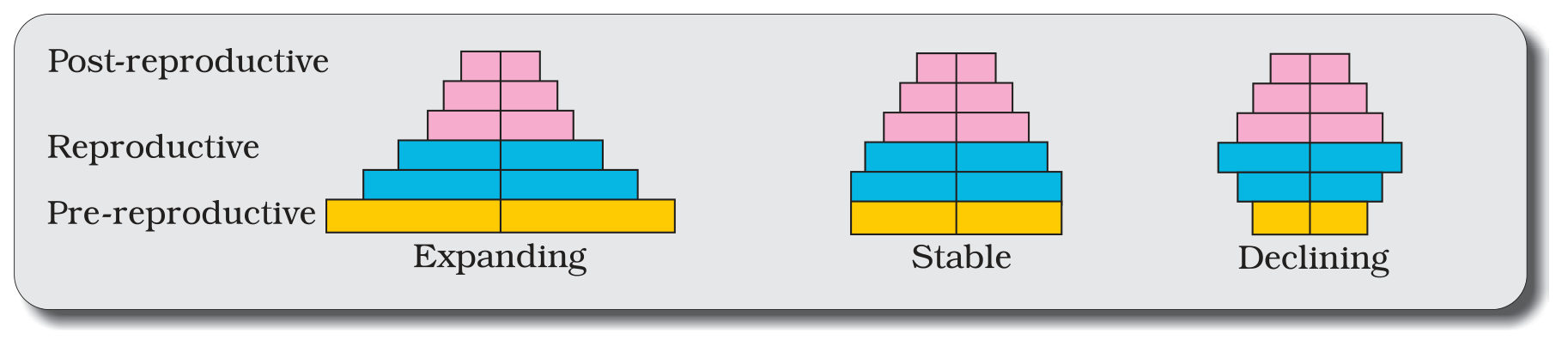
Textbook figure

Figure 11.1 Representation of age pyramids for human population

Advertisement

Practise more on Organisms and Populations

Chapter-wise mocks on the real NTA exam screen, with solutions and your rank. Your first mocks are free.

Start free mocks →

Advertisement

Next questions

  1. This question consists of a paragraph followed by four statements. You are required to read the paragraph carefully and select one statemen…General Aptitude Test · Verbal Reasoning
  2. Consider the following statements:(A) Specific phobias are the most commonly occurring type of phobia.(B) Intense and incapacitating fear a…Psychology · Psychological Disorders
  3. Identify the noun clause in the following sentence:After the new mall opened, the old shopkeeper wondered whether his regular customers wou…English · Grammar: Clauses
  4. Match list I with list II List I Part A List II Part B A. Patients came to Dr. Raman I. A Judge pronouncing a verdict B. Dr. Raman was more…English · Comprehension - (Narrative / Factual)
  5. Which of the following attitudes is generally the most difficult to change?Psychology · Attitudes and Social Cognition
  6. Assertion (A): Members of teams often possess complementary skills and share a strong commitment to a common goal or purpose.Reason (R): In…Psychology · Social Influence and Group Processes
  7. Match List – I with List – II.List - IList - II(A) Mutualism(I) Tiger and Deer(B) Commensalism(II) Cuscuta and hedge plant(C) Parasitism(II…Biology · Organisms and Populations
  8. What is the purpose of an ESOP "exercise period"?Accountancy Part A · Accounting for Shares
  9. Which of the following statements is/are correct about the age structure?Geography · Fundamentals of Human Geography: Population Composition
  10. If cos α, cos β, cos γ are the direction cosines of vector a , then value of cos 2α + cos 2β + cos 2γ is equal to:Maths. Section B1 · Three-dimensional Geometry