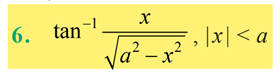
The simplest form of \(\tan^{-1}\left\{\displaystyle\frac{x}{\sqrt{a^2-x^2}}\right\}\) is, where \(-a \lt x \lt a\).
Answer & explanation
Correct answer: option 4
The correct answer is Option (4) → \(\sin^{-1}\displaystyle\frac{x}{a}\)
The expression \(\sqrt{a^2-x^2}\) suggests the substitution \(x=a\sin\theta\). Since \(-a \lt x \lt a\), we can take \(-\frac{\pi}{2} \lt \theta \lt \frac{\pi}{2}\), where \(\cos\theta \gt 0\):
\(\sqrt{a^2-x^2}=\sqrt{a^2-a^2\sin^2\theta}=a\cos\theta\)
So
\( \displaystyle \tan^{-1}\left\{\frac{x}{\sqrt{a^2-x^2}}\right\}=\tan^{-1}\left(\frac{a\sin\theta}{a\cos\theta}\right) \)
\(=\tan^{-1}(\tan\theta)=\theta\)
because \(\theta\) lies in \(\left(-\frac{\pi}{2}, \frac{\pi}{2}\right)\), the principal range of \(\tan^{-1}\). From \(x=a\sin\theta\):
\( \displaystyle \theta=\sin^{-1}\frac{x}{a} \)
NCERT (2026-27 edition):
Properties of Inverse Trigonometric Functions