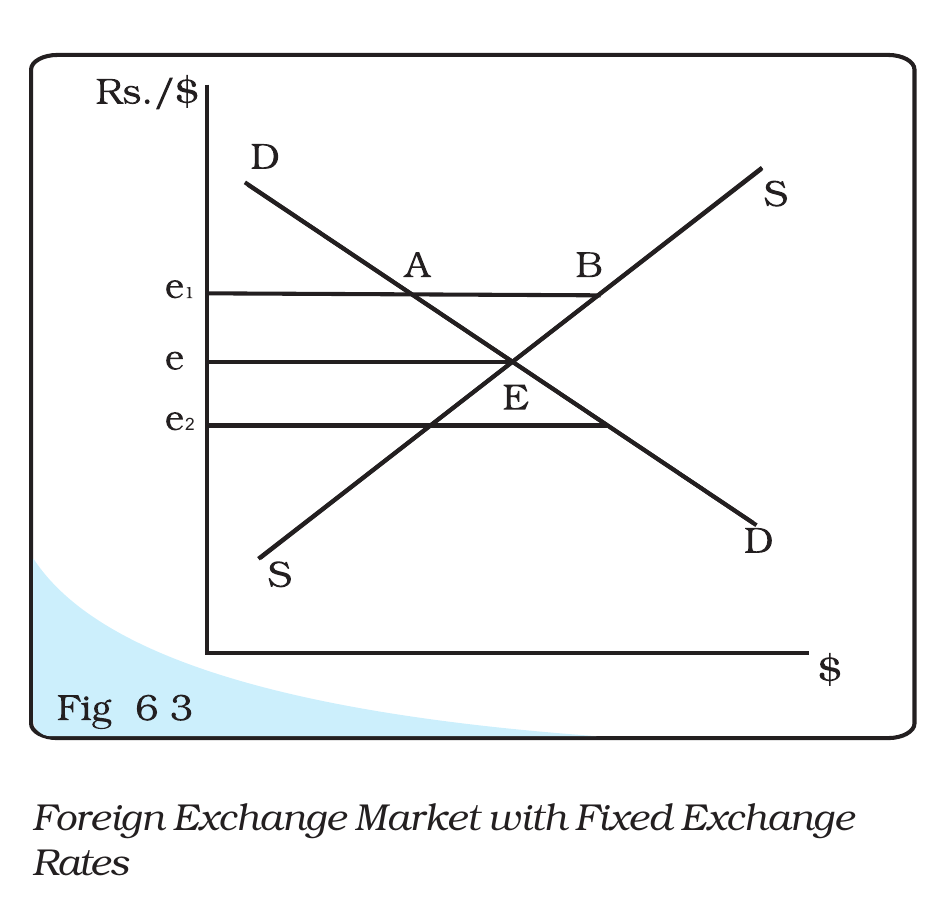
Arrange the following statements in correct sequence relating to change in exchange rate between Dollars and Rupee.
(A) The Central Bank intervenes to purchase dollars in the foreign exchange market.
(B) The government sets the exchange rate above the equilibrium exchange rate.
(C) This will absorb the excess supply of dollars in the foreign exchange market.
(D) It will result in excess supply of dollars in the foreign exchange market.
Choose the correct answer from the options given below :
Answer & explanation
Correct answer: option 1
The correct answer is Option (1) → (B), (D), (A), (C)
Under a fixed exchange rate, the government fixes the rate and the central bank defends it in the foreign exchange market.
(B) The government sets the exchange rate above the equilibrium exchange rate. — The government fixes more rupees per dollar than the market rate, to make the rupee cheaper for foreigners.
(D) It will result in excess supply of dollars in the foreign exchange market. — At this higher rate, the supply of dollars exceeds the demand for dollars.
(A) The Central Bank intervenes to purchase dollars in the foreign exchange market. — To hold the rate, the central bank buys dollars for rupees.
(C) This will absorb the excess supply of dollars in the foreign exchange market. — The purchase absorbs the excess supply, so the fixed rate holds.
NCERT (2026-27): “Fixed Exchange Rates In this exchange rate system, the Government fixes the exchange rate at a particular level. … the market determined exchange rate is e. However, let us suppose that for some reason the Indian Government wants to encourage exports for which it needs to make rupee cheaper for foreigners it would do so by fixing a higher exchange rate, say Rs 70 per dollar from the current exchange rate of Rs 50 per dollar. Thus, the new exchange rate set by the Government is e1, where e1 > e. At this exchange rate, the supply of dollars exceeds the demand for dollars. The RBI intervenes to purchase the dollars for rupees in the foreign exchange market in order to absorb this excess supply which has been marked as AB in the figure. Thus, through intervention, the Government can maintain any exchange rate in the economy. But it will be accumulating more and more foreign exchange so long as this intervention goes on.…”
|