CUETMOCK
  • Pricing
  • Mentors
Log inStart freeStart free mocks→

First test, then trust

Try a free CUET mock test.

Join 5,00,000+ students who rehearsed exam day on the exact NTA screen before sitting CUET. On the web and on Android.

Start free mocks →Get the Android app
CUETMOCK

India's #1 CUET Mock Test Platform. Original NCERT-based questions on the exact NTA exam screen — trusted by 5,00,000+ students since CUET 2022.

Get it onGoogle PlayScan to download the CUETMOCK app

Mock tests

  • CUET mock test series
  • Browse all papers
  • Commerce mocks
  • Humanities (Arts) mocks
  • Science mocks
  • Languages & GAT mocks
  • Free practice questions
  • Pricing

Resources

  • CUET exam guide
  • CUET syllabus
  • Universities accepting CUET
  • Expert blogs
  • News & notifications
  • Webinars & counselling
  • CUET score calculator
  • How we estimate your rank
  • FAQs

Company

  • About us
  • Our leadership & team
  • Our toppers
  • Mentors
  • For schools
  • Contact us
  • Terms
  • Privacy
  • Refund policy

Talk to us

+91 7696 6630 56info@cuetmock.comWhatsApp us

Our other platforms

  • JEE Mock — For IIT-JEE aspirants
  • NEET Mock — For NEET aspirants

Newsletter

Exam updates, study material and offers — no spam.

© 2026 NYC Ventures Pvt. Ltd.

701-702, Royal Business Park, Zirakpur, Punjab - 140603

  • Terms of use
  • Privacy policy
  • Refund policy
  • Contact us

iCUETMOCK is an independent preparation platform, not affiliated with the National Testing Agency (NTA). Always check exam details on the official NTA website.

  • Home
  • Mock tests
  • CUET guide
  • Pricing
  • Log in
Home/Practice questions/Fine Arts
Fine ArtsThe Bengal School and Cultural Nationalism

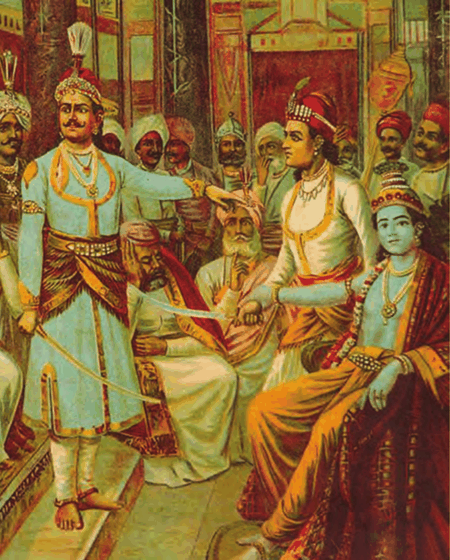
Identify the medium of this image:

Observe the image and answer the question:
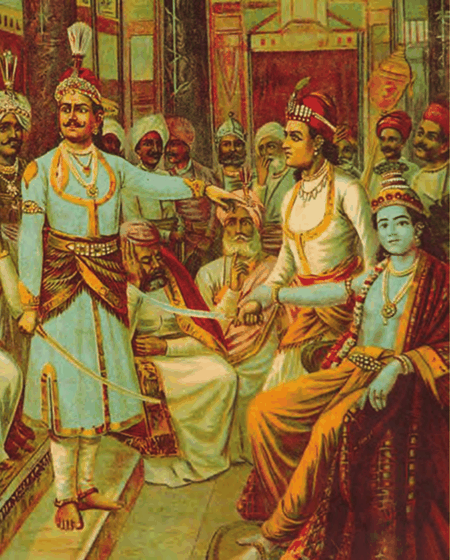
The painting

Identify the medium of this image:

Answer & explanation+

Correct answer: option 3

The correct answer is Option (3) → Oleograph

Note: The given answer is as per the official NTA Answer Key. For this question, Option (1) could also be a possible answer, as explained below.

Raja Ravi Varma’s paintings became so popular that many were copied as oleographs and sold in the market. They even entered people’s homes as calendar pictures.

Option (1) Planography — Should also be correct, though not the answer given by NTA. Planography is printing from a flat surface, and lithography is its main method. Ravi Varma mastered the art of lithographic reproduction, and the oleographs of his paintings were coloured lithographs. So the copies were made by planography, while Oleograph names the particular print.

Option (2) Screen printing — Incorrect. Here ink is pushed through a fine mesh screen onto the surface. Ravi Varma’s copies were not made this way.

Option (3) Oleograph — Correct. An oleograph is a coloured print made to look like an oil painting, the form in which Ravi Varma’s works reached the market.

Option (4) Aquatint — Incorrect. Aquatint is a kind of etching on a metal plate that gives areas of tone, as in Somnath Hore’s prints.


NCERT (2026-27): “Raja Ravi Varma …They are best seen in the works produced by self-taught artist, Raja Ravi Varma of the Travancore Court in Kerala. By imitating copies of European paintings popular in Indian palaces, he mastered the style of academic realism and used it to depict scenes from popular epics like the Ramayana and Mahabharata. They became so popular that many of his paintings were copied as oleographs and were sold in market.…”

“Rama Vanquishing the Pride of the Ocean This is a Puranic (ancient mythological stories) theme painted by Raja Ravi Varma. He was one of the first Indian painters to use oil paint and master the art of lithographic reproduction for mythological subject.…”

NCERT extract

Raja Ravi Varma, Krishna as envoy, 1906. NGMA, New Delhi, India

Advertisement

Practise more on The Bengal School and Cultural Nationalism

Chapter-wise mocks on the real NTA exam screen, with solutions and your rank. Your first mocks are free.

Start free mocks →

Advertisement

Next questions

  1. The numbers 2, 3, 4 and 5 occur (2 + 5k), (5k - 7), (2k - 3) and (k + 2) times, respectively. The average of the numbers is 2.85. Later on,…General Aptitude Test · Numerical Ability
  2. Tests show that the lump of metal is copper. Recent archaeological finds suggest that the Harappans probably also brought copper from which…History · Ancient India: Bricks, Beads and Bones
  3. Rajasthani miniature paintings were coloured with mineral pigments. On what were these miniature paintings painted?Fine Arts · The Rajasthani Schools of Painting
  4. Which step comes next after ‘developing premises’ in the planning process?Business Studies · Planning
  5. Which of the following relations is true?General Aptitude Test · General Knowledge
  6. Select the most appropriate synonym of the given word. REPROACHEnglish · Synonyms
  7. Which of the following cannot reduce Fehling’s solution?Chemistry · Organic: Aldehydes, Ketones and Carboxylic Acids
  8. The policy mentioned in the passage is in alignment with:English · Comprehension - (Narrative / Factual)
  9. India is a federal country with _______ tiered government. Which of the following option suits best in the above blank?Economics · Indian Economic Development: Human Capital Formation in India
  10. Families are usually parts of larger networks of people defined as what?History · Ancient India: Kinship, Caste and Class