
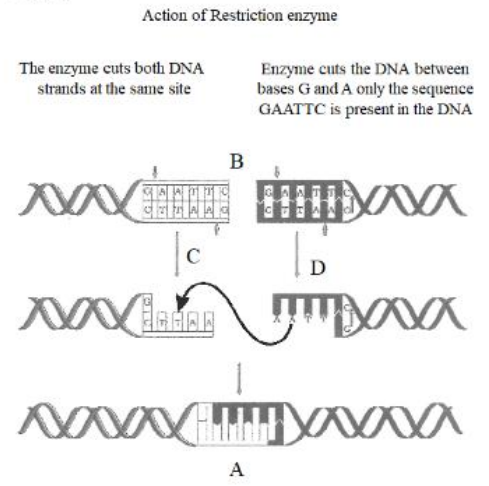
Restriction enzymes belong to a larger class of enzymes called nucleases. These are of two kinds; exonucleases and endonucleases. Exonucleases remove nucleotides from the ends of the DNA whereas, endonucleases make cuts at specific positions within the DNA. Each restriction endonuclease functions by ‘inspecting’ the length of a DNA sequence. Once it finds its specific recognition sequence, it will bind to the DNA and cut each of the two strands of the double helix at specific points in their sugar -phosphate backbones. Each restriction endonuclease recognises a specific nucleotide sequences in the DNA.
Nucleases represent what type of enzyme
Answer & explanation
Correct answer: option 4
The correct answer is Option (4) →Hydrolases
Nucleases are a type of enzyme that catalyzes the hydrolysis of the phosphodiester bonds in nucleic acids (DNA or RNA), breaking them down into smaller fragments or individual nucleotides. Enzymes that break bonds by adding water molecules (hydrolysis) are classified as hydrolases.
- Peptidases break down peptides into amino acids.
- Lipases break down lipids (fats) into fatty acids and glycerol.
- Restriction enzymes are a specific class of nucleases that cut DNA at particular sequences, but they are still classified under the broader category of hydrolases.
Therefore, nucleases belong to the category of hydrolases.