Read the following passage and answer the questions.
Suppose there is a market consisting of identical firms producing the same quality of salt.
Suppose the market demand curve and the market supply curve for salt are given by:
\( Q_D=350-p \) for \( 0 ≤ p ≤ 350 \)
= 0 for p > 350
\( Q_S = 220 + p \) for \( p ≥ 10 \)
= 0 for 0 ≤ p < 10
Where \( Q_D \) and \( Q_S \) denote the demand for and supply of salt (in kg) respectively and p denotes the price of salt per kg in rupees.
If the government imposes a price ceiling of Rs 31 on salt, what will be the volume of excess demand/ supply in the market?
Answer & explanation
Correct answer: option 1
The correct answer is Option (1) → Excess demand of 68 units.
Given:
QD = 350 − p
QS = 220 + p
Price ceiling, p = Rs 31
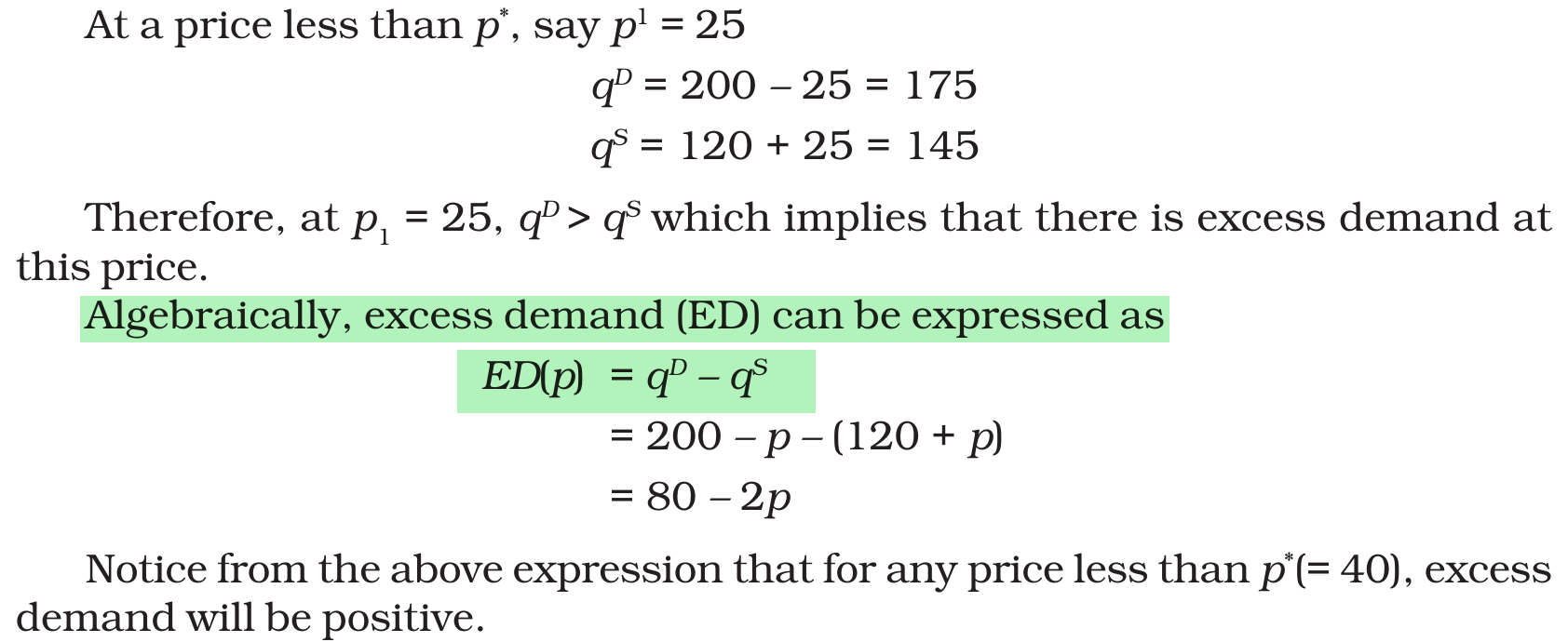
A price ceiling is the highest price the government allows. To compare the two sides, find the quantity demanded and the quantity supplied at this price:
QD = 350 − 31 = 319
QS = 220 + 31 = 251
Excess demand = 319 − 251 = 68 units
Buyers want more salt than sellers offer at this low price, so the gap is excess demand.
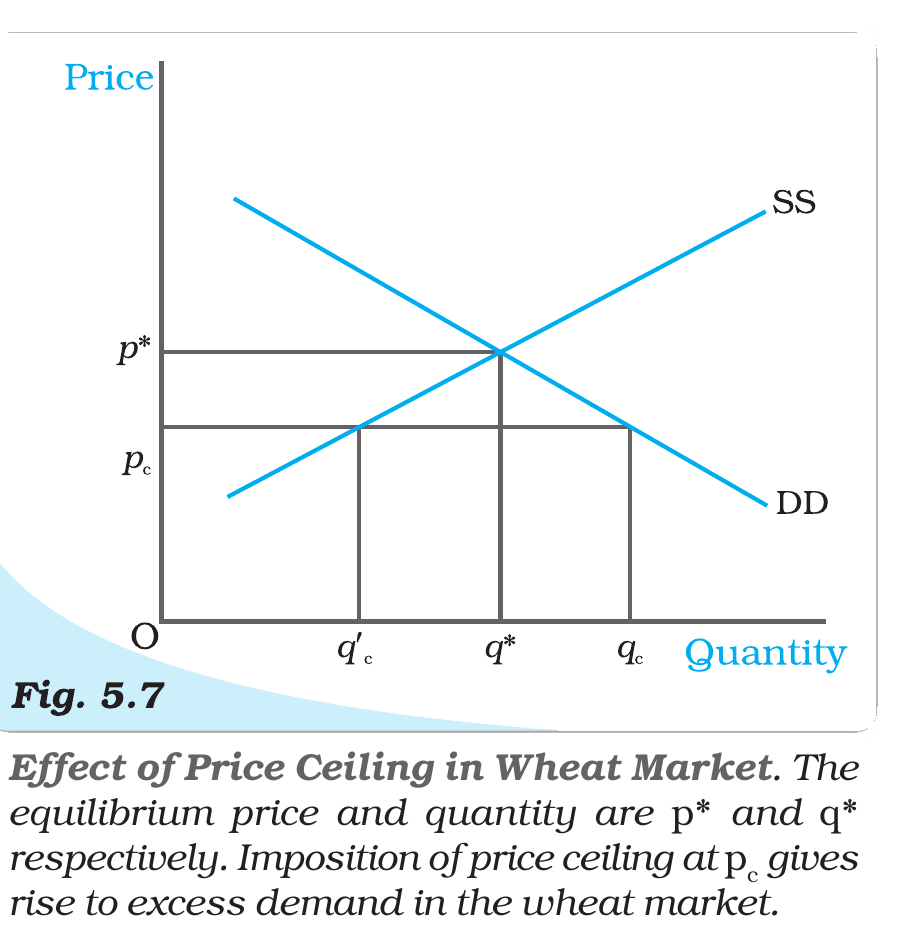
NCERT (2026-27): “5.2.1 Price Ceiling It is not very uncommon to come across instances where government fixes a maximum allowable price for certain goods. The government-imposed upper limit on the price of a good or service is called price ceiling. Price ceiling is generally imposed on necessary items like wheat, rice, kerosene, sugar and it is fixed below the market-determined price since at the market-determined price some section of the population will not be able to afford these goods. Figure 5.7 shows the market supply curve SS and the market demand curve DD for wheat. The equilibrium price and quantity of wheat are p* and q* respectively. When the government imposes price ceiling at pc which is lower than the equilibrium price level, there will be an excess demand for wheat in the market at that price. The consumers demand qc kilograms of wheat whereas the firms supply qc' kilograms.…”
|