Read the paragraph below and answer the following question.
CHIPKO MOVEMENT
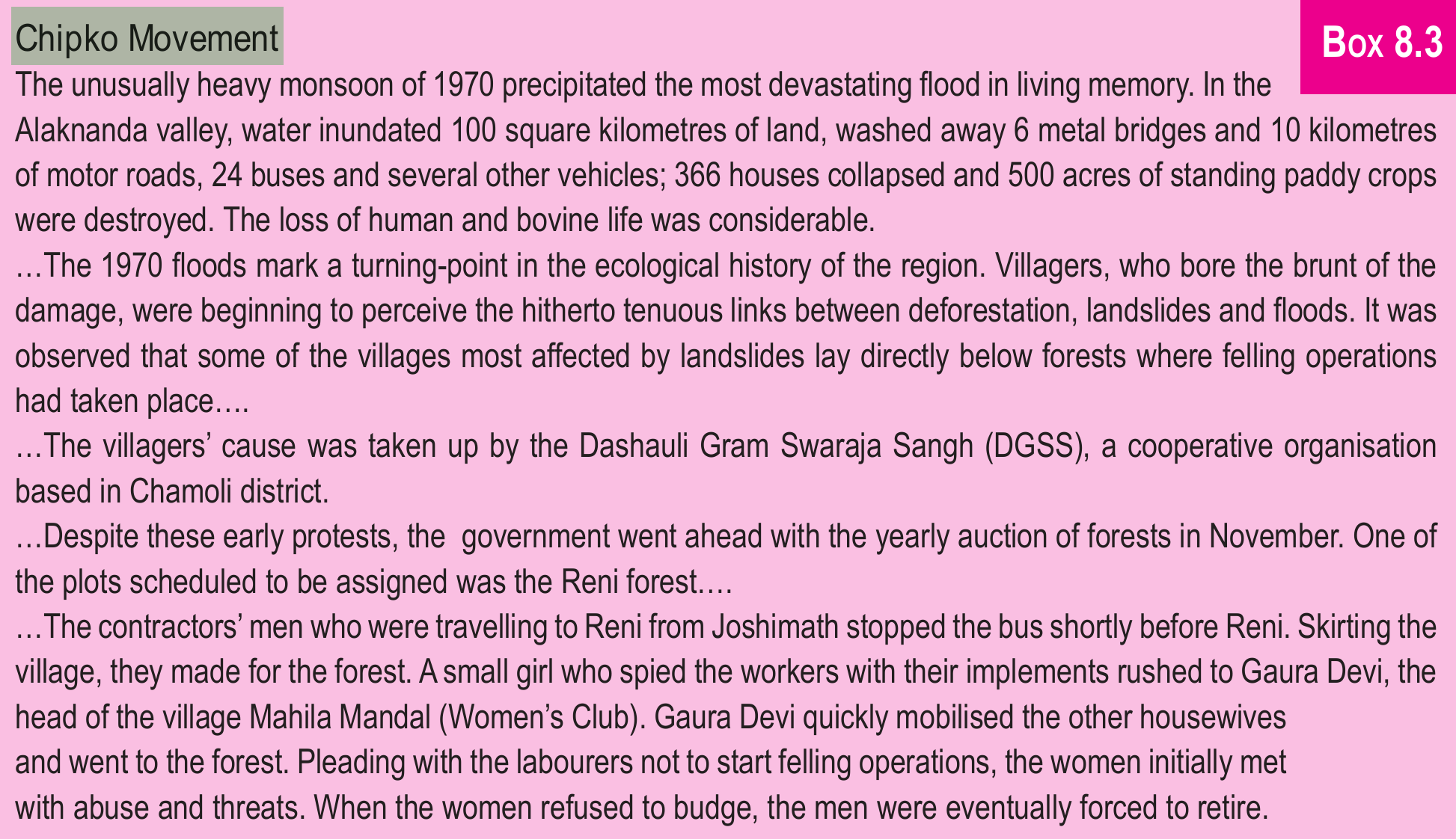
The unusually heavy monsoon of 1970 precipitated the most devastating flood in living memory. In the Alaknanda valley, water inundated 100 square kilometers of land, washed away 6 metal bridges and 10 kilometers of motor roads, 24 buses and several other vehicles; 366 houses collapsed and 500 acres of standing paddy crops were destroyed. The loss of human and bovine life was considerable.
...The 1970 floods mark a turning-point in the ecological history of the region. Villagers, who bore the brunt of the damage, were beginning to perceive the hitherto tenuous links between deforestation, landslides and floods. It was observed that some of the villages most affected by landslides lay directly below forests where forests felling operations had taken place....... .... The villagers' cause was taken up by the Dashauli Gram Swaraja Sangh (DGSS), a cooperative organisation based in Chamoli district.
.... Despite these early protests, the government went ahead with the yearly auction of forests in November. One of the plots scheduled to be assigned was the Reni forest....
.... The contractors' men who were travelling to Reni from Johimath stopped the bus shortly before Reni. Skirting the village, they made for the forest. A small girl who spied the workers with their implements rushed to Gaura Devi, the head of the village Mahila Mandal (Women's Club). Gaura Devi quickly mobilised the other housewives and went to the forest. Pleading with the labourers not to start felling operations, the women initially met with abuse and threats.
When the women refused to budge, the men were eventually forced to retire.
The Chipko Movement has also been identified as a Green issue. Identify the reason behind this.
Answer & explanation
Correct answer: option 3
The correct answer is Option (3) → It sought to highlight the villager’s respect for the forest as a form of wealth other than money
Option (1) It sought to empower the powerless villagers — Incorrect. Giving a voice to poor villagers against a distant and powerful government was part of the social inequality side of Chipko, the ‘red’ issue. It explains why the movement was a struggle of the powerless, not why it is called a Green issue.
Option (2) It sought to stall the government desire of profit from selling timber — Incorrect. The clash between the villagers’ livelihood and the government’s desire to earn revenue from selling timber was the economy of subsistence set against the economy of profit. That is the ‘red’ issue of livelihood and inequality, not the green one.
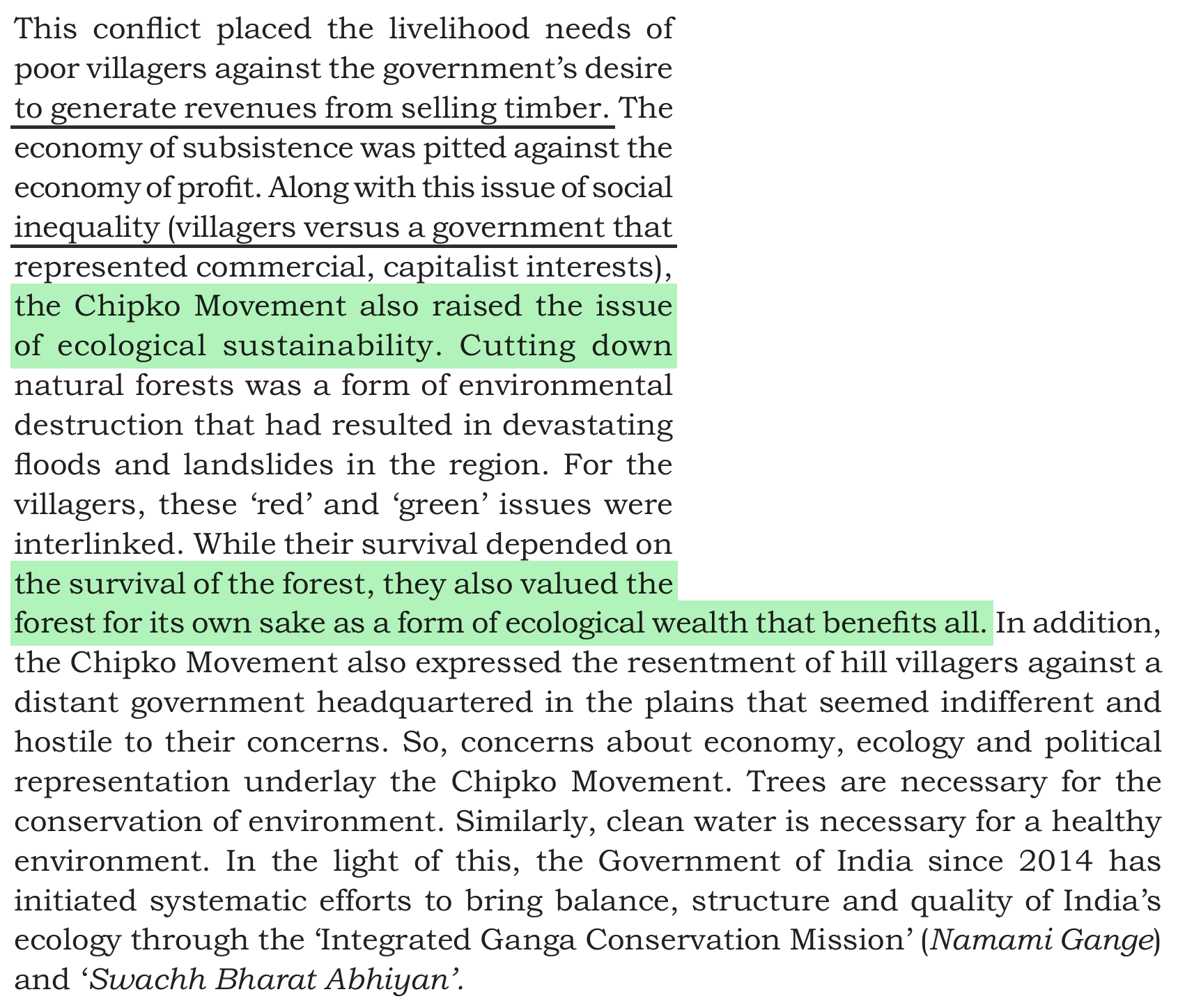
Option (3) It sought to highlight the villager’s respect for the forest as a form of wealth other than money — Correct. A Green issue is an issue of ecological sustainability: protecting nature for its own sake. Besides needing the forest to survive, the villagers valued the forest for its own sake as a form of ecological wealth that benefits all, a wealth that cannot be counted in money. Cutting natural forests had also brought floods and landslides, so saving the trees was saving the environment.
Option (4) It was supported by villagers and not by urban dwellers — Incorrect. Who supported the movement says nothing about the issue it raised. Chipko is called a Green issue because of what it fought for, the forest and the environment, not because of where its supporters lived.
Note: This passage is taken from Box 8.3 ‘Chipko Movement’ of the chapter ‘Social Movements’ in NCERT, and the body text beside the box explains the ‘red’ and ‘green’ issues that the questions ask about. NTA built five questions on one box here, so read the boxes of every chapter as closely as the main text.
NCERT: Social Change and Development in India — Chapter 8: Social Movements (2025-26)
|