
If primary producers are exposed to 1,000,000 Joules of sunlight, the amount of energy transferred to tertiary consumers will be:
Answer & explanation
Correct answer: option 2
The correct answer is Option (2) - 1000 J
Note: The given answer is as per NTA. However, the answer appears to be wrong due to the explanation given below. The correct answer should be Option 4: 10 J.
-
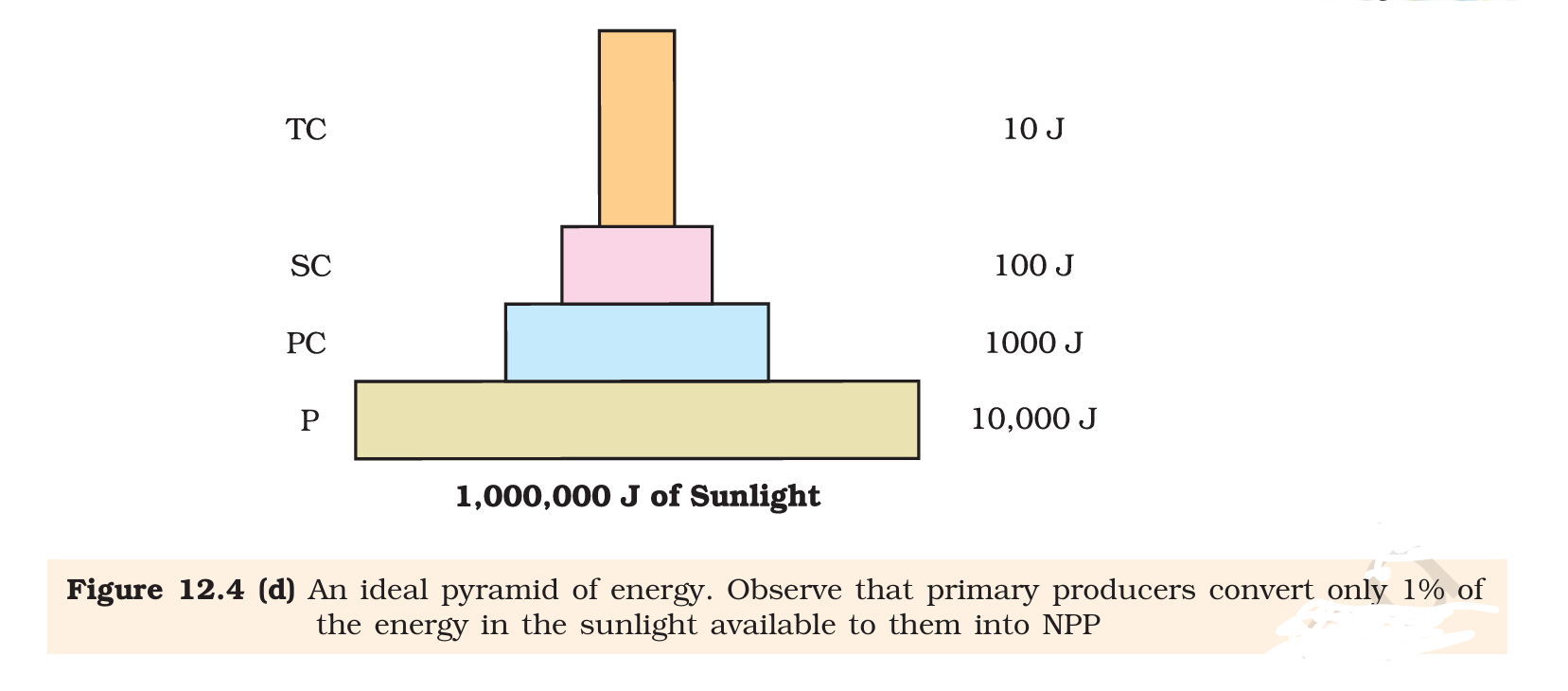
only about 1% of the incident solar energy is converted into Net Primary Productivity (NPP) by producers.
-
So, from 1,000,000 J sunlight, producers store 1% = 10,000 J.
-
After this, energy transfer follows the 10% law at each trophic level.
- Step-wise transfer:
-
Producers (NPP) = 10,000 J
-
Primary Consumers receive 10% = 1,000 J
-
Secondary Consumers receive 10% = 100 J
-
Tertiary Consumers receive 10% = 10 J
Why NTA might have chosen Option 2:
NTA appears to have chosen Option 2 (1000 J) assuming that the 1,000,000 J was treated as energy already available at the producer level rather than total solar radiation. From that stage onward, only the 10% law of energy transfer between trophic levels was applied: 10% to primary consumers (100,000 J), 10% of that to secondary consumers (10,000 J), and 10% again to tertiary consumers (1,000 J). Thus, Option 2 results when the calculation begins directly from producers, whereas considering the initial reduction of solar energy before trophic transfer leads to the scientifically more precise answer of 10 J.