CUETMOCK
  • Pricing
  • Mentors
Log inStart freeStart free mocks→

First test, then trust

Try a free CUET mock test.

Join 5,00,000+ students who rehearsed exam day on the exact NTA screen before sitting CUET. On the web and on Android.

Start free mocks →Get the Android app
CUETMOCK

India's #1 CUET Mock Test Platform. Original NCERT-based questions on the exact NTA exam screen — trusted by 5,00,000+ students since CUET 2022.

Get it onGoogle PlayScan to download the CUETMOCK app

Mock tests

  • CUET mock test series
  • Browse all papers
  • Commerce mocks
  • Humanities (Arts) mocks
  • Science mocks
  • Languages & GAT mocks
  • Free practice questions
  • Pricing

Resources

  • CUET exam guide
  • CUET syllabus
  • Universities accepting CUET
  • Expert blogs
  • News & notifications
  • Webinars & counselling
  • CUET score calculator
  • How we estimate your rank
  • FAQs

Company

  • About us
  • Our leadership & team
  • Our toppers
  • Mentors
  • For schools
  • Contact us
  • Terms
  • Privacy
  • Refund policy

Talk to us

+91 7696 6630 56info@cuetmock.comWhatsApp us

Our other platforms

  • JEE Mock — For IIT-JEE aspirants
  • NEET Mock — For NEET aspirants

Newsletter

Exam updates, study material and offers — no spam.

© 2026 NYC Ventures Pvt. Ltd.

701-702, Royal Business Park, Zirakpur, Punjab - 140603

  • Terms of use
  • Privacy policy
  • Refund policy
  • Contact us

iCUETMOCK is an independent preparation platform, not affiliated with the National Testing Agency (NTA). Always check exam details on the official NTA website.

  • Home
  • Mock tests
  • CUET guide
  • Pricing
  • Log in
Home/Practice questions/Accountancy Part A
Accountancy Part AAccounting for Shares

Sometimes shareholders pay a part or the whole of the amount of calls…

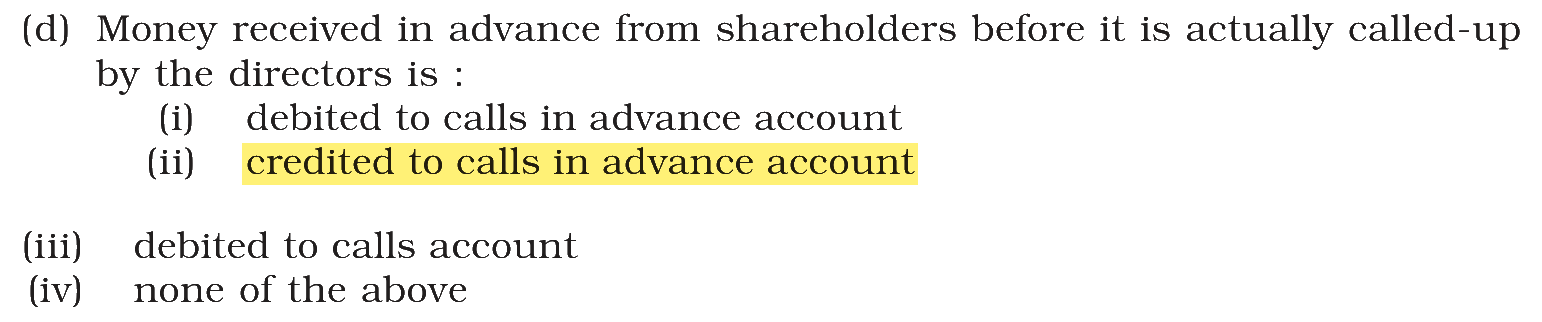
Sometimes shareholders pay a part or the whole of the amount of calls not yet made. The amount so received from shareholders is:

Answer & explanation+

Correct answer: option 4

The correct answer is Option (4) → Credited to calls in Advance Account

NCERT (2026-27 edition):
Calls in Advance – “Sometimes shareholders pay a part or the whole of the amount of the calls not yet made. The amount so received from the shareholders is known as “Calls in Advance”. The amount received in advance is a liability of the company and should be credited to ‘Call in Advance Account.”

NCERT (2026-27 edition):
Test your Understanding – II

Extract from the NCERT textbook

NCERT (2026-27 edition):
Answers to Test your Understanding

Extract from the NCERT textbook

Advertisement

Practise more on Accounting for Shares

Chapter-wise mocks on the real NTA exam screen, with solutions and your rank. Your first mocks are free.

Start free mocks →

Advertisement

Next questions

  1. Why is family considered a primary social institution?Sociology · Indian Society: Continuity and Change
  2. Which of the following non-farm sectors has the potential but seriously lacks infrastructure and other support?Economics · Indian Economic Development: Rural Development
  3. For an RLC circuit driven with voltage of amplitude v_m and frequency ω_0=1/(√LC) the current exhibits resonance. The quality factor, Q is…Physics · Alternating Current
  4. These lines are from a speech in the Constituent Assembly; the speaker's later lines have been left out. What did the speaker finally propo…History · Modern India: Framing the Constitution
  5. Income and expenditure account is based on which of the following methods of accounting?Accountancy Part A · Accounts for Non Profit Organsiation
  6. Area of the bounded region between the curve y = |x - 2| and the line y = 2 is:Maths. Section B1 · Application of Integrals
  7. Which of the following is INCORRECTLY spelled.English · Spelling Check
  8. What was Sawai Madho Singh attracted to getting recorded during his reign?Fine Arts · The Rajasthani Schools of Painting
  9. " One who is indifferent to pleasure or pain ".English · One Word
  10. In which year did the independence movement begin in Lithuania, later spreading to Estonia and Latvia?Political Science · Contemporary World Politics: End of Bi-Polarity