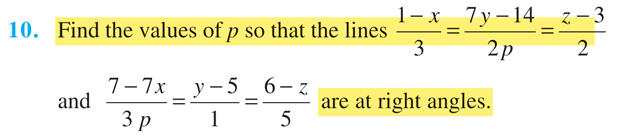
The value of λ so that the lines \( \displaystyle\frac{1-x}{3}=\frac{7y-14}{2\lambda}=\frac{z-3}{2} \) and \( \displaystyle\frac{7-7x}{3\lambda}=\frac{y-5}{1}=\frac{6-z}{5} \) are at right angles is:
Answer & explanation
Correct answer: option 4
The correct answer is Option (4) → \( \displaystyle\frac{70}{11} \)
Direction ratios can be read off only when a line is in the standard form \( \frac{x-x_1}{a}=\frac{y-y_1}{b}=\frac{z-z_1}{c} \), where the coefficients of x, y and z are all 1. Then (a, b, c) are the direction ratios.
Line 1: \( 1-x=-(x-1) \) and \( 7y-14=7(y-2) \), so
\( \displaystyle \frac{x-1}{-3}=\frac{y-2}{2\lambda/7}=\frac{z-3}{2} \)
\( \displaystyle \text{Direction ratios: }\left(-3,\ \frac{2\lambda}{7},\ 2\right) \)
Line 2: \( 7-7x=-7(x-1) \) and \( 6-z=-(z-6) \), so
\( \displaystyle \frac{x-1}{-3\lambda/7}=\frac{y-5}{1}=\frac{z-6}{-5} \)
\( \displaystyle \text{Direction ratios: }\left(-\frac{3\lambda}{7},\ 1,\ -5\right) \)
The lines are perpendicular when \( a_1a_2+b_1b_2+c_1c_2=0 \):
\( \displaystyle (-3)\left(-\frac{3\lambda}{7}\right)+\frac{2\lambda}{7}(1)+2(-5)=0 \)
\( \displaystyle \frac{9\lambda}{7}+\frac{2\lambda}{7}-10=0 \)
\( \displaystyle \frac{11\lambda}{7}=10 \)
\( \displaystyle \lambda=\frac{70}{11} \)
Tip: Never read direction ratios off the denominators before making the coefficients of x, y and z equal to +1; here both the signs (1 − x, 6 − z) and the factor 7 (7y, 7x) change them.
NCERT (2026-27 edition):
Angle between Two Lines