
CUETMOCK
  • Pricing
  • Mentors
Log inStart freeStart free mocks→

First test, then trust

Try a free CUET mock test.

Join 5,00,000+ students who rehearsed exam day on the exact NTA screen before sitting CUET. On the web and on Android.

Start free mocks →Get the Android app
CUETMOCK

India's #1 CUET Mock Test Platform. Original NCERT-based questions on the exact NTA exam screen — trusted by 5,00,000+ students since CUET 2022.

Get it onGoogle PlayScan to download the CUETMOCK app

Mock tests

  • CUET mock test series
  • Browse all papers
  • Commerce mocks
  • Humanities (Arts) mocks
  • Science mocks
  • Languages & GAT mocks
  • Free practice questions
  • Pricing

Resources

  • CUET exam guide
  • CUET syllabus
  • Universities accepting CUET
  • Expert blogs
  • News & notifications
  • Webinars & counselling
  • CUET score calculator
  • How we estimate your rank
  • FAQs

Company

  • About us
  • Our leadership & team
  • Our toppers
  • Mentors
  • For schools
  • Contact us
  • Terms
  • Privacy
  • Refund policy

Talk to us

+91 7696 6630 56info@cuetmock.comWhatsApp us

Our other platforms

  • JEE Mock — For IIT-JEE aspirants
  • NEET Mock — For NEET aspirants

Newsletter

Exam updates, study material and offers — no spam.

© 2026 NYC Ventures Pvt. Ltd.

701-702, Royal Business Park, Zirakpur, Punjab - 140603

  • Terms of use
  • Privacy policy
  • Refund policy
  • Contact us

iCUETMOCK is an independent preparation platform, not affiliated with the National Testing Agency (NTA). Always check exam details on the official NTA website.

  • Home
  • Mock tests
  • CUET guide
  • Pricing
  • Log in
Home/Practice questions/Physics
PhysicsElectrostatic Potential and Capacitance

Charge Q is given to the upper plate of an isolated parallel plate ca…

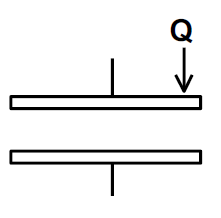
Charge Q is given to the upper plate of an isolated parallel plate capacitor of capacitance C. The potential difference between the plates
Answer & explanation+

Correct answer: option 3

In general, for charge Q1 and Q2 on upper and lower plate respectively the charge distributions on outer and inner part of the plates are shown in figure.
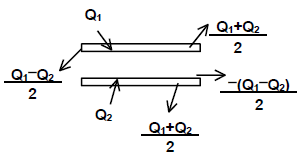
Here Q1 = Q, Q2 = 0

∴ Charge on inner side of plate are $\frac{Q}{2}$ and $-\frac{Q}{2}$ respectively.

Hence $V=\frac{Q / 2}{C}$

Hence (C) is correct choice.

Advertisement

Practise more on Electrostatic Potential and Capacitance

Chapter-wise mocks on the real NTA exam screen, with solutions and your rank. Your first mocks are free.

Start free mocks →

Advertisement

Next questions

  1. Which of the following statements are incorrect ? A. α-cells in Islet of Langerhans secrete insulin. B. Glucagon acts mainly on the liver c…Biology · Chemical Coordination and Integration
  2. Two parallel plates of areas A_1 and A_2 (A_1lt A_2) are placed a distance d apart, as shown in the figure. Neglecting edge effects, the ca…Physics · Electrostatic Potential and Capacitance
  3. What is the colour of the light emitted by the Sun?General Aptitude Test · General Knowledge
  4. Which way of tracing descent did most ruling dynasties from about the sixth century BCE onwards claim to follow?History · Ancient India: Kinship, Caste and Class
  5. Identify the government deficit calculated by the following formula:Net borrowing at home + Borrowing from RBI + Borrowing from abroad.Economics · Macro Economics: Government Budget and Economy
  6. Reactivity order of the following alkyl halides towards dehydrohalogenation is :(A) (B) (C) (D) Choose the correct answer from the options…Chemistry · Organic: Haloalkanes and Haloarenes
  7. Which of the following folk dances does NOT belong to the state of Mizoram?General Aptitude Test · General Knowledge
  8. Which country has a fused legal profession of 'advocates and solicitors'?Legal Studies · Legal Profession in India
  9. If xy = e^(x-y) , then displaystyledy/dx is equal to:Maths. Section A · Continuity and Differentiability
  10. If L + M means that L is the father of M, L × B means that L is the mother of M, L - M means that L is the brother of M then which of the f…General Aptitude Test · Verbal Reasoning