
Reactivity order of the following alkyl halides towards dehydrohalogenation is:
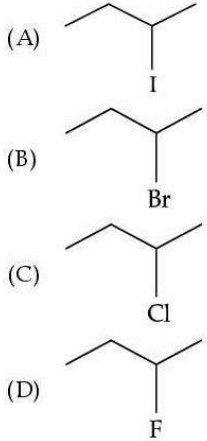
Choose the correct answer from the options given below:
Answer & explanation
Correct answer: option 1
The correct answer is Option (1) → (A) > (B) > (C) > (D)
Dehydrohalogenation of alkyl halides occurs mainly through the E2 elimination reaction in the presence of a base. The rate of elimination largely depends on the leaving group ability of the halogen.
The leaving group ability of halides follows the order:
I⁻ > Br⁻ > Cl⁻ > F⁻
This is because:
-
Iodide ion is the largest and most stable, so it leaves easily.
-
Fluoride ion is the smallest and strongly bonded to carbon, so it leaves with difficulty.
In the given compounds, the carbon skeleton is the same; only the halogen changes:
-
(A) Alkyl iodide
-
(B) Alkyl bromide
-
(C) Alkyl chloride
-
(D) Alkyl fluoride
Thus, the ease of elimination follows the leaving group ability:
R–I > R–Br > R–Cl > R–F
Therefore, the reactivity order towards dehydrohalogenation is:
(A) > (B) > (C) > (D).