Match List-I (ion) with List-II (approximate spin-only magnetic moment). (Atomic numbers: Fe = 26, Co = 27, Ni = 28, Cu = 29)
| List-I | List-II |
| (A) Cu2+ | (p) 2.9 BM |
| (B) Fe2+ | (q) 4.0 BM |
| (C) Ni2+ | (r) 1.8 BM |
| (D) Co2+ | (s) 5.0 BM |
Choose the correct answer from the options given below:
Answer & explanation
Correct answer: option 1
The correct answer is Option (1) → A-r, B-s, C-p, D-q
For a first-series transition metal ion the magnetic moment depends only on the number of unpaired electrons n, through the spin-only formula:
\( \displaystyle \mu=\sqrt{n(n+2)}\ \mathrm{BM} \)
Fe, Co and Ni lose their two 4s electrons to form M2+ (Cu loses its one 4s electron and one 3d electron), and the d electrons then occupy the five 3d orbitals singly before pairing.
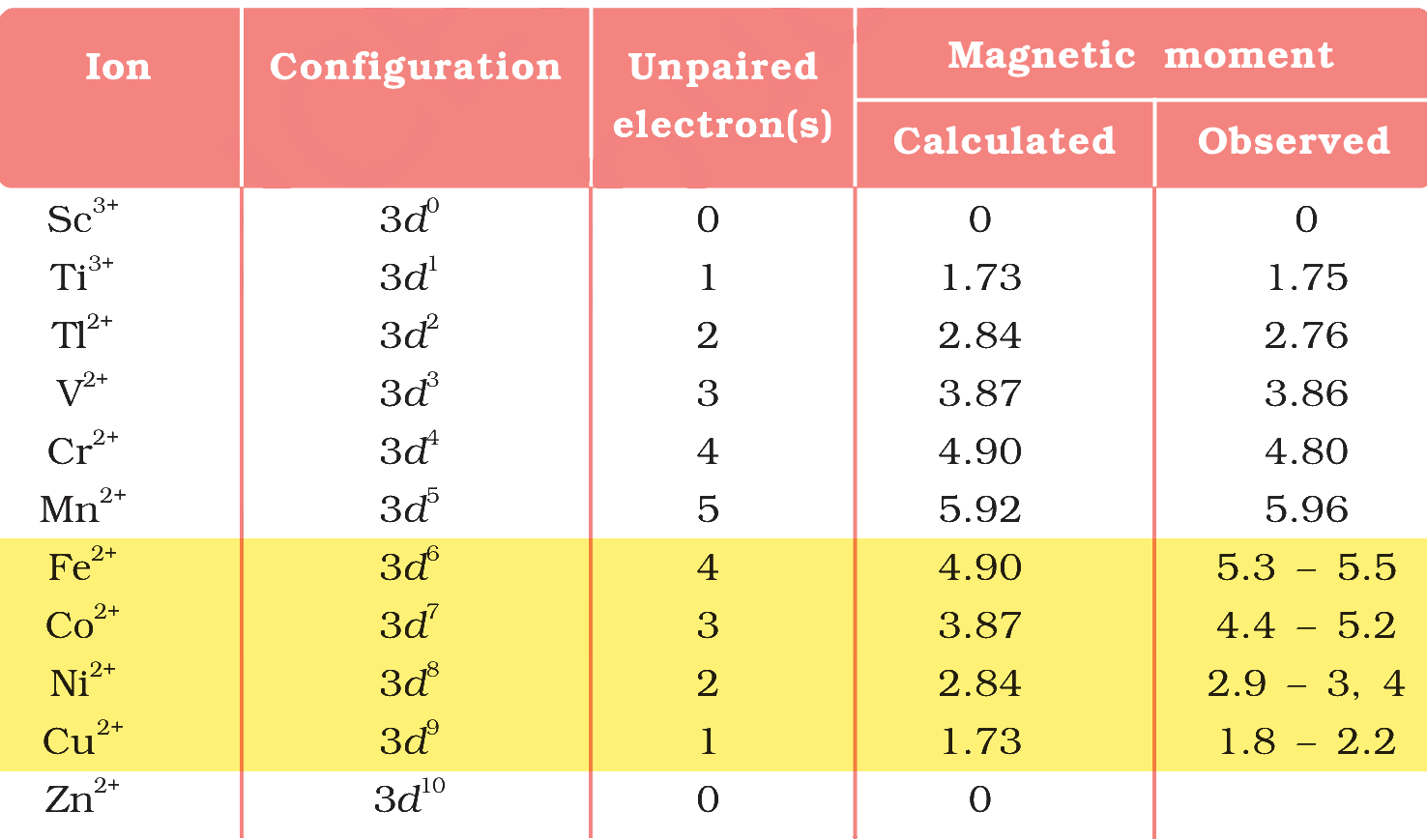
(A) Cu2+ — This matches (r) 1.8 BM. Cu (Z = 29) is [Ar]3d104s1, so Cu2+ is 3d9 with 1 unpaired electron: \( \mu=\sqrt{1\times3}=1.73\ \mathrm{BM} \approx 1.8\ \mathrm{BM} \).
(B) Fe2+ — This matches (s) 5.0 BM. Fe (Z = 26) is [Ar]3d64s2, so Fe2+ is 3d6 with 4 unpaired electrons: \( \mu=\sqrt{4\times6}=4.90\ \mathrm{BM} \approx 5.0\ \mathrm{BM} \).
(C) Ni2+ — This matches (p) 2.9 BM. Ni (Z = 28) is [Ar]3d84s2, so Ni2+ is 3d8 with 2 unpaired electrons: \( \mu=\sqrt{2\times4}=2.84\ \mathrm{BM} \approx 2.9\ \mathrm{BM} \).
(D) Co2+ — This matches (q) 4.0 BM. Co (Z = 27) is [Ar]3d74s2, so Co2+ is 3d7 with 3 unpaired electrons: \( \mu=\sqrt{3\times5}=3.87\ \mathrm{BM} \approx 4.0\ \mathrm{BM} \).
NCERT (2026-27 edition):
4.3.9 Magnetic Properties – “… For these, the magnetic moment is determined by the number of unpaired electrons and is calculated by using the ‘spin-only’ formula, i.e., \( \mu=\sqrt{n(n+2)} \) where n is the number of unpaired electrons and μ is the magnetic moment in units of Bohr magneton (BM). … The magnetic moments calculated from the ‘spin-only’ formula and those derived experimentally for some ions of the first row transition elements are given in Table 4.7.”
Table 4.7: Calculated and Observed Magnetic Moments (BM)