Which of the following has the highest dipole moment?
Answer & explanation
Correct answer: option 1
The correct answer is Option (1) → CH3Cl
The C–X bond is polar because the halogen is more electronegative than carbon.
The dipole moment of the bond is the product of the charge separated and the distance between the charges, so it depends on both the polarity and the bond length.
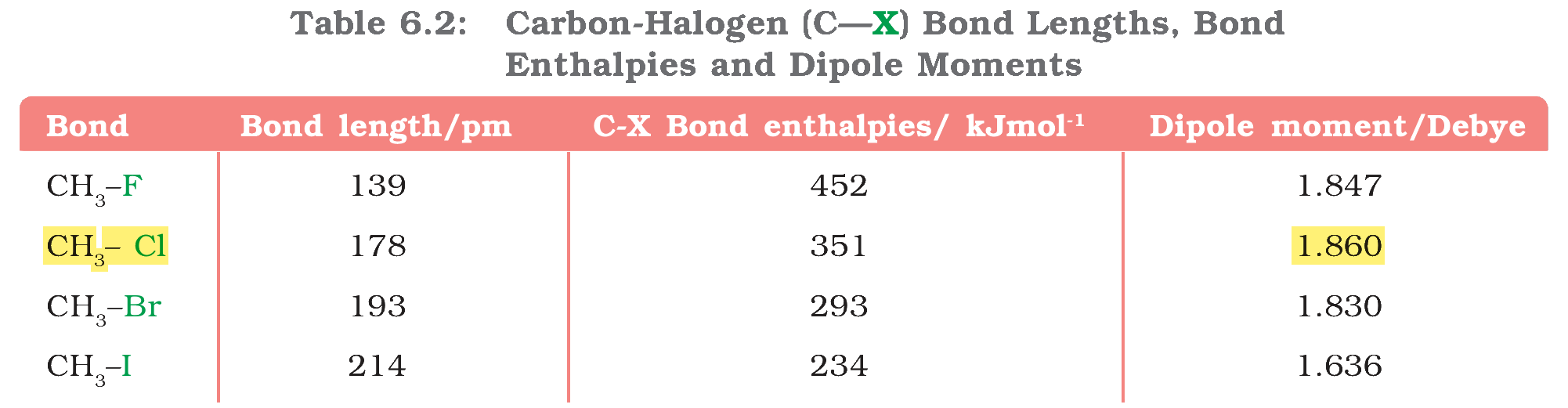
In \( \ce{CH3Cl} \) chlorine is highly electronegative and the C–Cl bond (178 pm) is much longer than C–F, so the product is the largest: 1.860 D.
Why the other options are incorrect
Option (2) CH3Br — Incorrect. The C–Br bond is longer, but bromine is less electronegative, so the charge separated is smaller: 1.830 D.
Option (3) CH3I — Incorrect. Iodine is the least electronegative halogen, so the C–I bond is the least polar: 1.636 D, the lowest of the four.
Option (4) CH3F — Incorrect. The C–F bond is the most polar, but it is also the shortest (139 pm), so its dipole moment (1.847 D) is a little below that of \( \ce{CH3Cl} \).
NCERT (2026-27 edition):
6.3 Nature of C-X Bond – “As we go down the group in the periodic table, the size of halogen atom increases. Fluorine atom is the smallest and iodine atom is the largest. Consequently the carbon-halogen bond length also increases from C–F to C–I. Some typical bond lengths, bond enthalpies and dipole moments are given in Table 6.2.”
Table 6.2: Carbon-Halogen (C—X) Bond Lengths, Bond Enthalpies and Dipole Moments