


CUET Preparation Today
Which of the following reactions are involved in preparation of aldehydes? (A) Gatterman-Koch reaction Choose the correct answer from the options given below: |
(A), (B) and (C) only (B), (C) and (D) only (A), (B), (C) and (D) (A), (B) and (D) only |
(A), (B), (C) and (D) |
The correct answer is Option (3) → (A), (B), (C) and (D) Aldehydes can be prepared by:
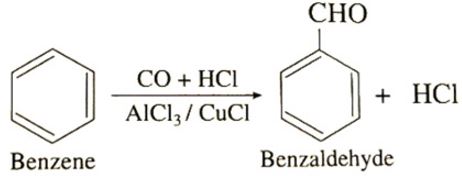
Each named reaction listed is a known aldehyde preparation method. Option-wise Explanation of Reactions (A) Gatterman–Koch reaction Benzene + $\text{CO} + \text{HCl}$ in presence of $\text{AlCl}_3/\text{CuCl}$ introduces a $-\text{CHO}$ group directly on the aromatic ring. This reaction is specifically used to prepare aromatic aldehydes.
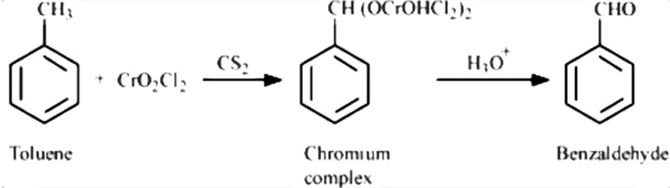
(B) Etard Reaction Toluene is oxidized with chromyl chloride ($\text{CrO}_2\text{Cl}_2$) to give benzaldehyde. It selectively converts the methyl side chain of aromatics into an aldehyde.
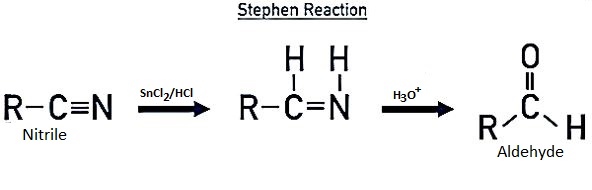
(C) Stephen Reaction Nitriles ($\text{R--CN}$) are reduced using $\text{SnCl}_2/\text{HCl}$ to form an iminium salt, which on hydrolysis gives aldehydes. This is a classic laboratory method for preparing aldehydes from nitriles.
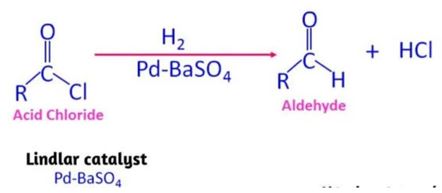
(D) Rosenmund Reaction Acid chlorides (RCOCI) are reduced with $H_2/Pd-BaSO_4$ (poisoned catalyst) to give aldehydes. The catalyst prevents further reduction to alcohol, making it aldehyde-selective.
|