CUETMOCK
  • Pricing
  • Mentors
Log inStart freeStart free mocks→

First test, then trust

Try a free CUET mock test.

Join 5,00,000+ students who rehearsed exam day on the exact NTA screen before sitting CUET. On the web and on Android.

Start free mocks →Get the Android app
CUETMOCK

India's #1 CUET Mock Test Platform. Original NCERT-based questions on the exact NTA exam screen — trusted by 5,00,000+ students since CUET 2022.

Get it onGoogle PlayScan to download the CUETMOCK app

Mock tests

  • CUET mock test series
  • Commerce mocks
  • Humanities (Arts) mocks
  • Science mocks
  • Languages & GAT mocks
  • Free practice questions
  • Pricing

Resources

  • CUET exam guide
  • CUET syllabus
  • Universities accepting CUET
  • Expert blogs
  • News & notifications
  • Webinars & counselling
  • CUET score calculator
  • How we estimate your rank
  • FAQs

Company

  • About us
  • Our leadership & team
  • Our toppers
  • Mentors
  • For schools
  • Contact us
  • Terms
  • Privacy
  • Refund policy

Talk to us

+91 7696 6630 56info@cuetmock.comWhatsApp us

Our other platforms

  • JEE Mock — For IIT-JEE aspirants
  • NEET Mock — For NEET aspirants

Newsletter

Exam updates, study material and offers — no spam.

© 2026 NYC Ventures Pvt. Ltd.

701-702, Royal Business Park, Zirakpur, Punjab - 140603

  • Terms of use
  • Privacy policy
  • Refund policy
  • Contact us

iCUETMOCK is an independent preparation platform, not affiliated with the National Testing Agency (NTA). Always check exam details on the official NTA website.

  • Home
  • Mock tests
  • CUET guide
  • Pricing
  • Log in
Home/Practice questions/History
HistoryModern India: Colonialism and the Countryside

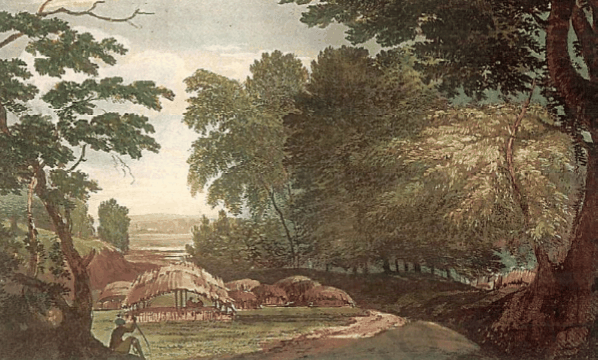
Which region is shown in the painting given below by the British arti…

Which region is shown in the painting given below by the British artist William Hodges?

Answer & explanation+

Correct answer: option 3

The correct answer is Option (3) → A hill village in Rajmahal

The painting is Hodges' 1782 view of a hill village in Rajmahal, made when he went to the Rajmahal hills in search of the picturesque.

NCERT (2026-27): “2.1 In the hills of Rajmahal …
Fig. 9.8 A view of a hill village in Rajmahal, painted by William Hodges, 1782 William Hodges was a British artist who accompanied Captain Cook on his second voyage to the Pacific (1772-75), and then came to India. In 1781 he became a friend of Augustus Cleveland, the Collector of Bhagalpur. On the invitation of Cleveland, Hodges accompanied him to the Jangal Mahals in 1782, and painted a set of aquatints. Like many other British painters of the time, Hodges searched for the picturesque. Artists in search of the picturesque were inspired by the ideals of Romanticism, a tradition of thought that celebrated nature and admired its magnificence and power. Romantics felt that to commune with nature the artist had to represent nature as an idyll, uncorrupted by modern civilisation, discover unknown landscapes, and appreciate the sublime play of light and shade. It is in search of this unknown that Hodges went to the Rajmahal hills. …”

Advertisement

Practise more on Modern India: Colonialism and the Countryside

Chapter-wise mocks on the real NTA exam screen, with solutions and your rank. Your first mocks are free.

Start free mocks →

Advertisement

Next questions

  1. Who was the first woman ruler of the Delhi Sultanate?General Aptitude Test · General Knowledge
  2. In which year did the Labour Government come into power in Britain?History · Modern India: Framing the Constitution
  3. Read the following statements carefully, with reference to Bharmour tehsil. (a) It is located in Chamba district of Himachal Pradesh. (b) I…Geography · India-People and Economy: Planning and Sustainable development in Indian Context
  4. Under the consumer responsibility, to buy only standardised goods since they provide quality assurance, the consumer should look for which…Business Studies · Consumer Protection
  5. Which of the following statement is incorrect about the magnetic field?Physics · Magnetism and Matter
  6. Match the social reformer in List - I with their contribution in List - II LIST-I(Social Reformer)LIST-II(Contribution)(A)Ayyankali(I)Gave…Sociology · Indian Society: Continuity and Change
  7. Select the option that can be used as a one-word substitute for the given group of words. A group of three novels or plays, each complete i…English · One Word
  8. The second number in the given number-pairs is obtained by performing certain mathematical operation(s) on the first number. The same opera…General Aptitude Test · General Ability
  9. The principle of ‘competitive exclusion' was stated by which among the following scientist?Biology · Organisms and Populations
  10. Which of the following is the solution of the given differential equation? y'=1+ y^ 2 /1+ x^ 2Maths. Section A · Differential Equations